

Lucas Museum First Look: What 1,300 Works Reveal About ‘Narrative Art’

The completed Lucas Museum of Narrative Art has opened its galleries to the press ahead of its September 22 public debut in Los Angeles. The first installation reveals a museum that places illustration, comics, murals, painting, photography, and film material within one field—but its display is more structured and its headline collection numbers less precise than the rhetoric of a hierarchy-free “people’s art” might suggest.
The Preview Turns an Opening Date Into a Curatorial Test
The opening date was not the news of the September 2 preview. The museum had announced September 22, 2026, ten months earlier. What changed was access: journalists could finally examine completed galleries rather than architectural renderings, collection highlights, and exhibition lists.
George Lucas and Mellody Hobson appeared at the September 2 media preview, according to the Associated Press. The reported $1 billion institution now joins the unusually dense Los Angeles museum landscape in Exposition Park, beside the California Science Center and near the University of Southern California.
The museum’s September 2 opening release describes a 300,000-square-foot building designed by Ma Yansong of MAD with Stantec. More than 100,000 square feet are devoted to art across more than 30 galleries. The inaugural exhibitions contain more than 1,300 works, while the surrounding 13-acre campus includes gardens and ten outdoor sculptures.
Those measurements do not, by themselves, explain what kind of museum Lucas and Hobson have built. That answer is visible in the organization of the opening hang.
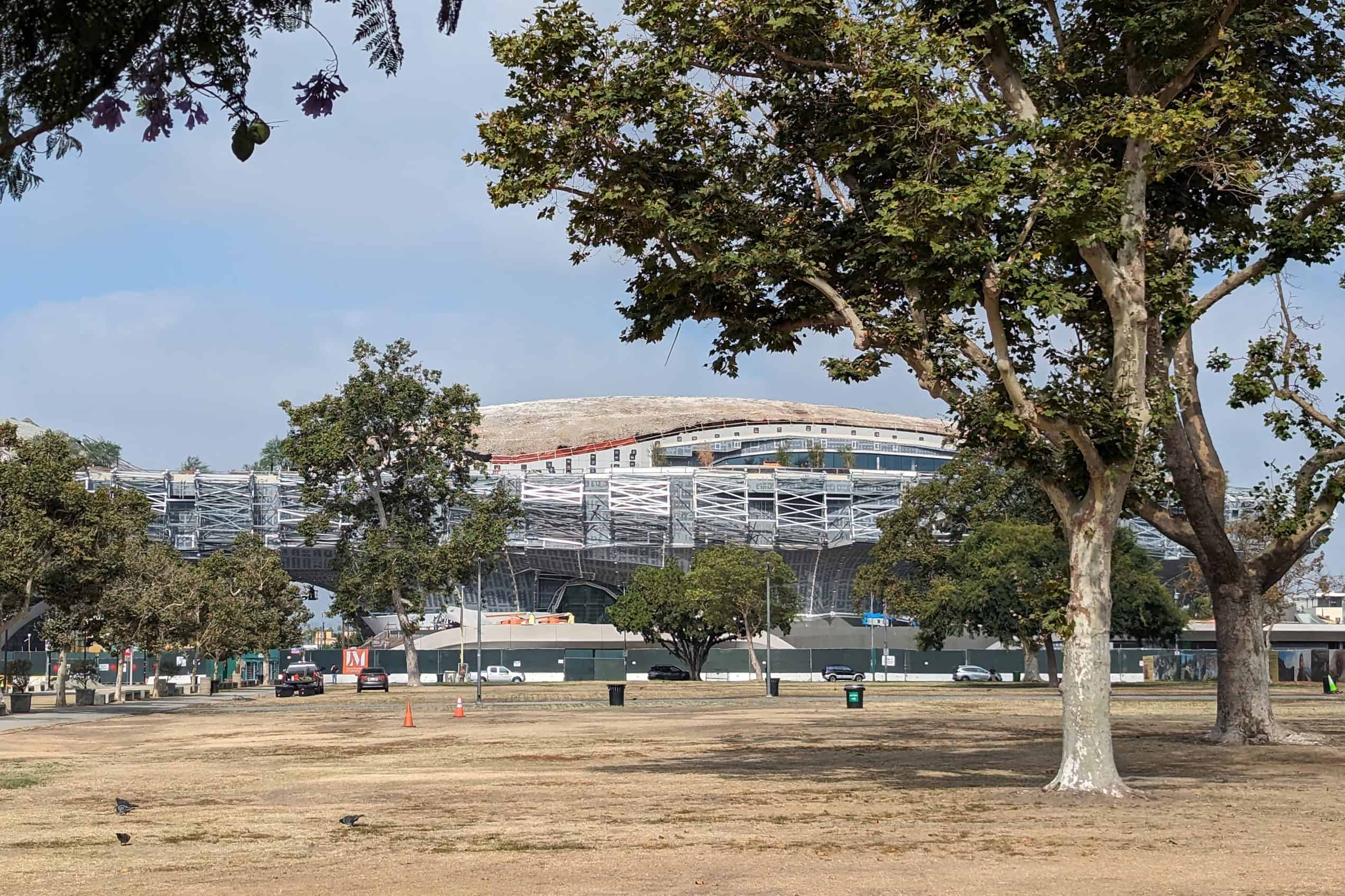
The Lucas Museum of Narrative Art under construction in Los Angeles in August 2023. Photograph by Jeremy Thompson, via Wikimedia Commons, licensed under Creative Commons Attribution 2.0 Generic; cropped.
What “Narrative Art” Means on These Walls
The museum defines narrative art as art created to tell stories through images. That criterion permits a wide field: cave imagery, religious painting, magazine illustration, comic strips, documentary photography, murals, cinema designs, costumes, and props can all enter the same institutional frame.
The galleries do not simply dissolve every classification, however. The official exhibition plan reveals three overlapping structures. Rooms devoted to family, love, work, sports, and civic life organize objects by subject. Other rooms retain medium labels such as photography, murals, manga, and comics. Six monographic galleries honor Thomas Hart Benton, Frank Frazetta, Jessie Willcox Smith, Maxfield Parrish, Norman Rockwell, and N.C. Wyeth.
That is a hybrid model, not the absence of hierarchy. Chronology, geography, and the traditional divide between fine and commercial art no longer provide the controlling framework, but distinctions among themes, media, and favored artists remain. The consequential choice is equal institutional standing: a comic drawing or magazine illustration is treated as capable of carrying cultural meaning without first being promoted into the category of painting.
Rockwell is the clearest test. His dedicated gallery includes The Problem We All Live With, the 1964 image of six-year-old Ruby Bridges escorted into a desegregated New Orleans school. The Los Angeles Times reported that the painting is on loan from the Norman Rockwell Museum. Its placement makes Rockwell’s storytelling—not his former status as a commercial illustrator—the relevant curatorial fact.
The arrangement differs from a fine-art display led principally by period, school, or nation. It also avoids making film production the organizing principle of the entire institution. Instead, cinema becomes one branch within a longer history of images used to transmit myths, identities, and social beliefs.
More Than 40,000 Works Does Not Mean 40,000 on View
The museum has published several figures that describe different things. Its November 2025 announcement said the permanent collection held more than 40,000 works and that 35 galleries occupied 100,000 square feet. The September 2026 release describes more than 1,300 works in the inaugural exhibitions across “30-plus” galleries. Thirty-five is compatible with “30-plus”; there is no evidence in those formulations that five galleries disappeared.
The published display minimum did change. An April 30 exhibition announcement promised more than 1,200 objects, while the final September release raised the published floor to more than 1,300. The museum did not explain that revision, so it should be treated as an updated minimum rather than evidence of exactly 100 late additions.
Dividing the two headline floors—1,300 and 40,000—produces 3.25 percent. It does not produce a defensible percentage of the collection on view. Both numbers are explicitly “more than” figures, and the opening experience also includes material outside a simple owned-artwork count. There are loans such as the Ruby Bridges painting and reproductions of immovable works and sites, including the Sistine Chapel ceiling, the Aztec Sun Stone, Altamira cave paintings, and Assyrian sculptures from the Louvre.
Breadth in an installation is not identical to breadth in a collection. The museum has not published a numerical breakdown of the 40,000-plus works by medium, period, geography, ownership source, or cataloging status. Nor has it supplied an exact count separating owned originals, loans, replicas, film artifacts, and digital presentations in the opening galleries.

The original Aztec Sun Stone in Mexico City; the Lucas Museum displays a reproduction. Photo: Juan Carlos Fonseca Mata, CC BY-SA 4.0.
“Star Wars” Is a Wing, Not the Museum’s Definition
Bates’s 7 percent figure refers to space, according to CBS Los Angeles, and establishes that Star Wars is a minority component of the museum.
Its presence is nevertheless substantial. A yellow Naboo N-1 Starfighter hangs near the public research library, while Star Wars in Motion presents vehicle designs, props, and costumes from the first six films. The complete Lucas Archives, covering 1971 through 2012, extends beyond that inaugural installation and includes material from other Lucasfilm productions.
Elsewhere, Frida Kahlo, Diego Rivera, Jacob Lawrence, Gordon Parks, Charles Schulz, Beatrix Potter, and Banksy appear within the same broad inquiry into how images construct shared stories. Global range is carried partly through original works and partly through the first-floor reproductions. Meanwhile, the six dedicated artist galleries concentrate on American painters and illustrators, showing that the opening argument is universal in ambition but especially deep in modern American visual culture.
The Opening Is Broader Than Star Wars, but the Numbers Stay Blurred
- More than 1,300 works appear across more than 30 galleries.
- The thematic, medium-based, and monographic layout challenges the fine-art/commercial-art divide without eliminating curatorial categories.
- Because the published collection and display figures are lower bounds and the galleries contain loans and reproductions, they cannot establish an exact percentage on view.
- Bates’s 7 percent figure refers to space, according to CBS Los Angeles, and establishes that Star Wars is a minority component of the museum.
- The institution has not released a medium-by-medium or geographic accounting of the more than 40,000 works.

Isabella studied at the University of Cape Town in South Africa and graduated with a Bachelor of Arts majoring in English Literature & Language and Psychology. Throughout her undergraduate years, she took Art History as an additional subject and absolutely loved it. Building on from her art history knowledge that began in high school, art has always been a particular area of fascination for her. From learning about artworks previously unknown to her, or sharpening her existing understanding of specific works, the ability to continue learning within this interesting sphere excites her greatly.
Her focal points of interest in art history encompass profiling specific artists and art movements, as it is these areas where she is able to really dig deep into the rich narrative of the art world. Additionally, she particularly enjoys exploring the different artistic styles of the 20th century, as well as the important impact that female artists have had on the development of art history.
Learn more about Isabella Meyer and the Art in Context Team.
Choose Art in Context as a preferred source to see more of our reporting in Google Top Stories and other Google Search experiences.
Cite this Article
Isabella, Meyer, “Lucas Museum First Look: What 1,300 Works Reveal About ‘Narrative Art’.” Art in Context. September 7, 2026. URL: https://artincontext.org/lucas-museum-first-look-narrative-art-opening/
Meyer, I. (2026, 7 September). Lucas Museum First Look: What 1,300 Works Reveal About ‘Narrative Art’. Art in Context. https://artincontext.org/lucas-museum-first-look-narrative-art-opening/
Meyer, Isabella. “Lucas Museum First Look: What 1,300 Works Reveal About ‘Narrative Art’.” Art in Context, September 7, 2026. https://artincontext.org/lucas-museum-first-look-narrative-art-opening/.


