

Argentina Orders Nazi-Looted Portrait Returned to Goudstikker Heir

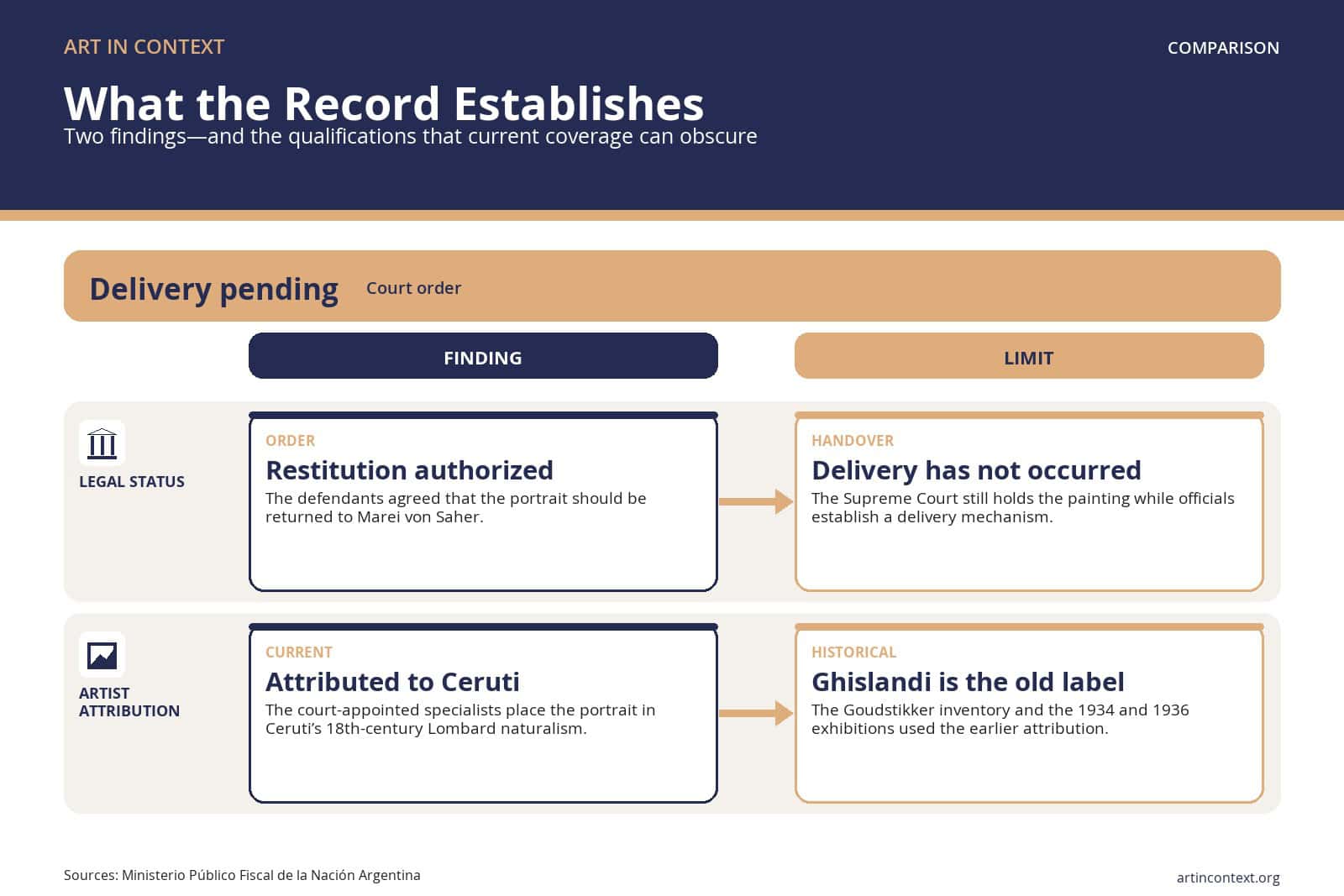
An Argentine federal judge approved the restitution of Portrait of a Lady to Marei von Saher, the sole heir of Dutch Jewish dealer Jacques Goudstikker, on September 4, 2026. The order advances the painting from court custody toward delivery, but it also exposes a factual problem in current coverage: Argentina’s court-appointed experts attribute the portrait to Giacomo Ceruti, not Giuseppe Ghislandi.
The Restitution Order Does Not Mean Delivery Has Happened
Judge Santiago Inchausti approved an agreement between federal prosecutors and the defense of Patricia Kadgien and Juan Carlos Cortegoso, the couple who had the painting in Mar del Plata. An official account of the September 4 hearing says both defendants renounced every civil or criminal claim to the work and consented to its return to von Saher.
The agreement conditionally suspends the criminal proceedings for two years; it is not an acquittal. Each defendant must donate 2.4 million Argentine pesos to the cooperative supporting Mar del Plata’s maternal and children’s hospital, maintain a fixed address, and report to the authority supervising criminal sentences. Prosecutors said the alternative was available because of the alleged offense’s sentencing range, the defendants’ lack of prior convictions, and the possibility that any sentence would have been suspended.
The painting itself remains in the custody of Argentina’s Supreme Court in Buenos Aires. Inchausti’s resolution is to be sent there so officials can establish a delivery mechanism. The legally decisive change, therefore, is that the competing possessors have surrendered their claims and the judge has authorized restitution; physical delivery to von Saher had not yet been reported when the order was announced.

Argentina’s Palace of Justice, where Portrait of a Lady remained in Supreme Court custody when the restitution order was announced. Photograph by Jrivell, hosted by Wikimedia Commons, under the Creative Commons Attribution-Share Alike 3.0 Unported license.
The Painting Is Now Attributed to Giacomo Ceruti
The artist’s name is not a minor caption detail. For decades, the portrait was recorded as a work by Giuseppe Vittore Ghislandi, also known as Fra Galgario. It appeared under that attribution in Goudstikker’s inventory and was exhibited as a Ghislandi at Amsterdam’s Stedelijk Museum in 1934 and at Nijenrode Castle in 1936.
That history explains the Ghislandi label in early reports, but it is no longer the current attribution in the Argentine case. A January 2026 expert report released by federal prosecutors says National Academy of Fine Arts specialists Ángel Miguel Navarro and Alejo Gabriel Lo Russo attribute the painting to Giacomo Antonio Melchiorre Ceruti, known as Il Pitocchetto. Their technical examination also matched it to the work documented in Goudstikker’s collection.
The specialists placed the painting in 18th-century Lombard naturalism and pointed to its close observation of clothing and its unidealized sitter as characteristics of Ceruti’s work. They also noted that the canvas is stable despite tears and evidence of three earlier interventions. Roberto Longhi assigned the work to Ceruti in 1927, and Mina Gregori incorporated it into her Ceruti catalogue in 1982, according to the prosecutors’ account.
A Guardian report credited to Agence France-Presse and published late on September 4 EDT nevertheless calls the painting a Ghislandi without mentioning the reattribution. The Associated Press, by contrast, distinguishes the historical Ghislandi cataloging from the National Academy experts’ Ceruti conclusion. Ceruti is the attribution used in the restitution proceeding; Ghislandi remains part of the object’s catalog history.
A Real Estate Photograph Reopened an 85-Year-Old Case
The September 2026 ruling is not the discovery event. Dutch journalist Peter Schouten traveled to Mar del Plata in April 2025 while investigating Friedrich Kadgien, Patricia Kadgien’s father and a Third Reich financial official who later lived in Argentina. A property listing for the family home showed the missing portrait hanging in a living room.
Algemeen Dagblad published the discovery on August 25, 2025. Argentina’s Mar del Plata federal prosecution unit received a report from INTERPOL Argentina that day and another from the national customs authority the next day. During a search on August 26, investigators found that the portrait had been removed and replaced; its outline remained visible on the wall.
Four more properties were searched on September 1, and Kadgien and Cortegoso were placed under house arrest. Their lawyer delivered the painting to prosecutors on September 3. It was later transferred to Supreme Court custody for security and conservation while ownership was resolved. Court-appointed specialists then authenticated the recovered canvas as the same object in the Dutch and Goudstikker records. The new order comes one year after that recovery and changes the work’s legal destination rather than its physical identity.
The Provenance Is Clearer Than the Wartime Handoff
The Dutch Cultural Heritage Agency’s object-level provenance record identifies the 119.5-by-89-centimeter oil on canvas and traces possible possession through Milanese collections before placing it with Goudstikker in Amsterdam from 1934 to July 1940. The next entry is the Goudstikker/Miedl art business after July 1940, followed by F. G. Kadgien in Berlin.
That sequence supports the painting’s connection to both Goudstikker and Kadgien, but it does not date or describe the handoff between the Goudstikker/Miedl business and Kadgien. The Associated Press reports that roughly 1,100 works from Goudstikker’s holdings were illegally sold to Hermann Göring, while explicitly stating that the route by which this particular portrait reached Kadgien remains unclear.
The Argentine prosecution’s language is similarly careful: its reconstruction says the work appears to have reached the accused woman’s family and identifies her father’s financial roles under the Third Reich. The restitution order settles who is entitled to receive the painting in this proceeding, but it does not fill that gap in the wartime chain of custody.

The former Goudstikker gallery building at Herengracht 458, Amsterdam, photographed in 1951 by Daan Noske/Anefo. Hosted by Wikimedia Commons under the Creative Commons CC0 1.0 Universal Public Domain Dedication.
A Public Exhibition Is Intended, Not Scheduled
Von Saher’s lawyers told Argentine authorities that she is willing to let the painting remain temporarily in Argentina for public display, with the aim of raising awareness about Nazi cultural plunder.
La Nación reported that the Buenos Aires Holocaust Museum had been considered and that Argentina’s Foreign Ministry was interested in another possibility. The same report said arrangements were still in progress. No institution has announced a venue, opening date, duration, or the painting’s destination after display. Those details depend first on the Supreme Court completing the handover process.
The Order Settles Ownership, Not Every Historical Question
The available records establish four bounded findings:
- The September 4 order authorizes restitution to Marei von Saher, while the painting remains in Supreme Court custody pending a delivery mechanism.
- Kadgien and Cortegoso have surrendered all claims, and their criminal proceeding is suspended for two years under conditions rather than concluded by an acquittal.
- Argentina’s National Academy specialists attribute the portrait to Giacomo Ceruti; the unqualified Ghislandi attribution in the AFP report is out of date, although it accurately reflects older catalogs.
- A Goudstikker family lawyer told Reuters that Alois Miedl sold the portrait to Friedrich Kadgien in 1944, while the venue and timing of any Argentine exhibition remain unannounced.

Isabella studied at the University of Cape Town in South Africa and graduated with a Bachelor of Arts majoring in English Literature & Language and Psychology. Throughout her undergraduate years, she took Art History as an additional subject and absolutely loved it. Building on from her art history knowledge that began in high school, art has always been a particular area of fascination for her. From learning about artworks previously unknown to her, or sharpening her existing understanding of specific works, the ability to continue learning within this interesting sphere excites her greatly.
Her focal points of interest in art history encompass profiling specific artists and art movements, as it is these areas where she is able to really dig deep into the rich narrative of the art world. Additionally, she particularly enjoys exploring the different artistic styles of the 20th century, as well as the important impact that female artists have had on the development of art history.
Learn more about Isabella Meyer and the Art in Context Team.
Choose Art in Context as a preferred source to see more of our reporting in Google Top Stories and other Google Search experiences.
Cite this Article
Isabella, Meyer, “Argentina Orders Nazi-Looted Portrait Returned to Goudstikker Heir.” Art in Context. September 5, 2026. URL: https://artincontext.org/argentina-nazi-looted-portrait-goudstikker-restitution/
Meyer, I. (2026, 5 September). Argentina Orders Nazi-Looted Portrait Returned to Goudstikker Heir. Art in Context. https://artincontext.org/argentina-nazi-looted-portrait-goudstikker-restitution/
Meyer, Isabella. “Argentina Orders Nazi-Looted Portrait Returned to Goudstikker Heir.” Art in Context, September 5, 2026. https://artincontext.org/argentina-nazi-looted-portrait-goudstikker-restitution/.


