
Smithsonian Artifact Loans and Grants Threatened: What the Letter Can Reach

The Interior Department has threatened to withdraw executive-agency support from Smithsonian museums through artifact loans, procurement assistance and discretionary grants unless the institution’s leadership changes course. The August 28 letter is an escalation, not an implemented cutoff: no loan, contract or grant is identified as canceled, and the Smithsonian’s separate congressional appropriation does not disappear by letter.
What the August 28 Smithsonian Letter Threatens
The threat became public in reports published September 2, but the underlying document is dated August 28. Interior Secretary Doug Burgum and White House Domestic Policy Council Director Vince Haley sent it to the Smithsonian’s Board of Regents rather than to Secretary Lonnie G. Bunch III, who had received the administration’s two principal document-demand letters in 2025.
The official August 28 letter says administration officials cannot continue supporting the Smithsonian under its current leadership. It gives three examples: loaning artifacts for exhibitions, enabling procurement processes and awarding discretionary grants. Burgum and Haley requested a meeting with the regents at their earliest convenience, but the letter sets no deadline for a cutoff.
| Support channel | Status on September 3 |
|---|---|
| Artifact loans | Named as an example of support. No lending agency, object, exhibition or recall date is identified. |
| Procurement assistance | The letter refers to enabling procurement processes but names no purchase, contract, vendor or suspension procedure. |
| Discretionary grants | No grantmaker, program, award, amount or termination date is specified. |
| Congressional appropriation | Separate from the three examples. The White House’s July report records a $1.0805 billion FY2026 appropriation; the new letter does not rescind it. |
That distinction is practical, not semantic. Artifact lending can determine which objects curators can place in an exhibition, while procurement assistance and grants can affect particular projects or operations. Without named agencies, objects or awards, however, the exposed relationships cannot yet be converted into a list of losses. These are possible points of leverage, not damage already done.
The White House’s July report itself distinguishes the annual appropriation from grants, gifts and business revenue. Separate does not mean immune from pressure: the administration has also pursued future appropriations and asserted conditions on apportioned funds. It means the August 28 letter’s three examples should not be reported as though Congress’s entire appropriation had already been withdrawn.
The Washington Post reported that a White House statement to The Atlantic suggested the letter was not a set of direct orders. By September 3, no agency had named a loan, procurement arrangement or grant that it would suspend, and no Smithsonian notice had reported the loss of such support.

The National Museum of American History in Washington, D.C., photographed by ajay_suresh. Wikimedia Commons, Creative Commons Attribution 2.0 Generic; cropped.
The Board of Regents, Not Interior, Controls Leadership
The choice of addressee reveals the administration’s strategy. The Smithsonian’s own institutional history says the Board of Regents governs the institution, elects its secretary, establishes major policies and approves budgets. By statute, its 17 seats are allocated to the vice president, chief justice, six members of Congress and nine citizens, although The Atlantic reported in July that two or three citizen seats were vacant. Museum directors report through the Smithsonian’s secretary, not to the Interior Department or Domestic Policy Council.
The new letter bypasses Bunch and appeals to the body that can evaluate his leadership. Associated Press reported in July that the president lacks authority to quickly fire Smithsonian leaders or order changes to exhibitions; The Washington Post likewise reported that Interior and the White House policy office have no direct authority over the institution. The letter consequently relies on support that executive agencies may control rather than purporting to issue a curatorial command.
Formal limits do not make indirect pressure inconsequential. On May 30, 2025, President Donald Trump said he had fired National Portrait Gallery director Kim Sajet. The Smithsonian responded that personnel decisions belonged to its secretary under board oversight, yet Sajet resigned on June 13 after the dispute. The episode demonstrates that political pressure can produce a personnel result without changing the institution’s formal chain of command.
Seventeen Months of Escalating Smithsonian Pressure
The August letter belongs to a campaign that began in March 2025 and gradually moved from policy directives to exhibition review, funding pressure and an appeal to the governing board.
| Date | Verified development |
|---|---|
| March 27, 2025 | Executive Order 14253 directed the vice president to pursue the policy through his role as a regent and told OMB and Interior to use measures within their authority. |
| May 30–June 13, 2025 | Trump claimed to fire Sajet; the Smithsonian asserted its personnel authority, and the Portrait Gallery director later resigned. |
| August 12 and December 18, 2025 | White House officials demanded exhibition plans, labels, collection information and governance records, then alleged that the production was incomplete. |
| July 4 and July 24, 2026 | The Domestic Policy Council issued its report on the National Museum of American History. Executive Order 14416 then directed officials to use available authorities and ordered signs on National Park Service property outside the museum. |
| August 28, 2026 | Burgum and Haley named artifact loans, procurement assistance and discretionary grants as possible leverage and requested a regents meeting. The letter was reported September 2. |
The chronology also exposes a clear error in the White House’s 162-page report. Its cover and first text page both say Executive Order 14253 was issued on March 27, 2026. The signed order is dated March 27, 2025, and the report’s own later chronology uses 2025. The earlier year is established by the permanent executive-order record: the campaign lasted approximately 17 months before the August letter, not five.

The Smithsonian Institution Building, known as the Castle, photographed by Minette Lontsie. Wikimedia Commons, Creative Commons Attribution-Share Alike 4.0 International.
An Allegation Is Not an Antidiscrimination Finding
The new letter also alleges that the administration uncovered evidence suggesting Smithsonian leaders may have violated federal antidiscrimination laws by creating a hostile workplace or distributing opportunities and benefits according to protected characteristics. The document does not identify that evidence. The Interior Department and White House supplied no examples when The Washington Post asked, and neither the letter nor the reporting cites an agency finding or court judgment. These remain allegations made by Burgum and Haley.
The Smithsonian declined to comment on the August letter. Its earlier responses address a different document and should not be mistaken for a reply to the new workplace allegations. In July, Bunch said the Domestic Policy Council’s report was not a fair characterization of the National Museum of American History. Museum director Anthea M. Hartig separately told a House subcommittee that the museum was fact-checking the report and that it did not fairly or accurately characterize the museum’s full body of work.
The administration has challenged how curators select objects, write labels and frame American history; the Smithsonian has defended scholarship, independence and the inclusion of additional evidence and voices. The August letter raises the cost of that disagreement by placing interagency support for exhibitions and operations on the table, while stopping short of documenting an actual withdrawal.
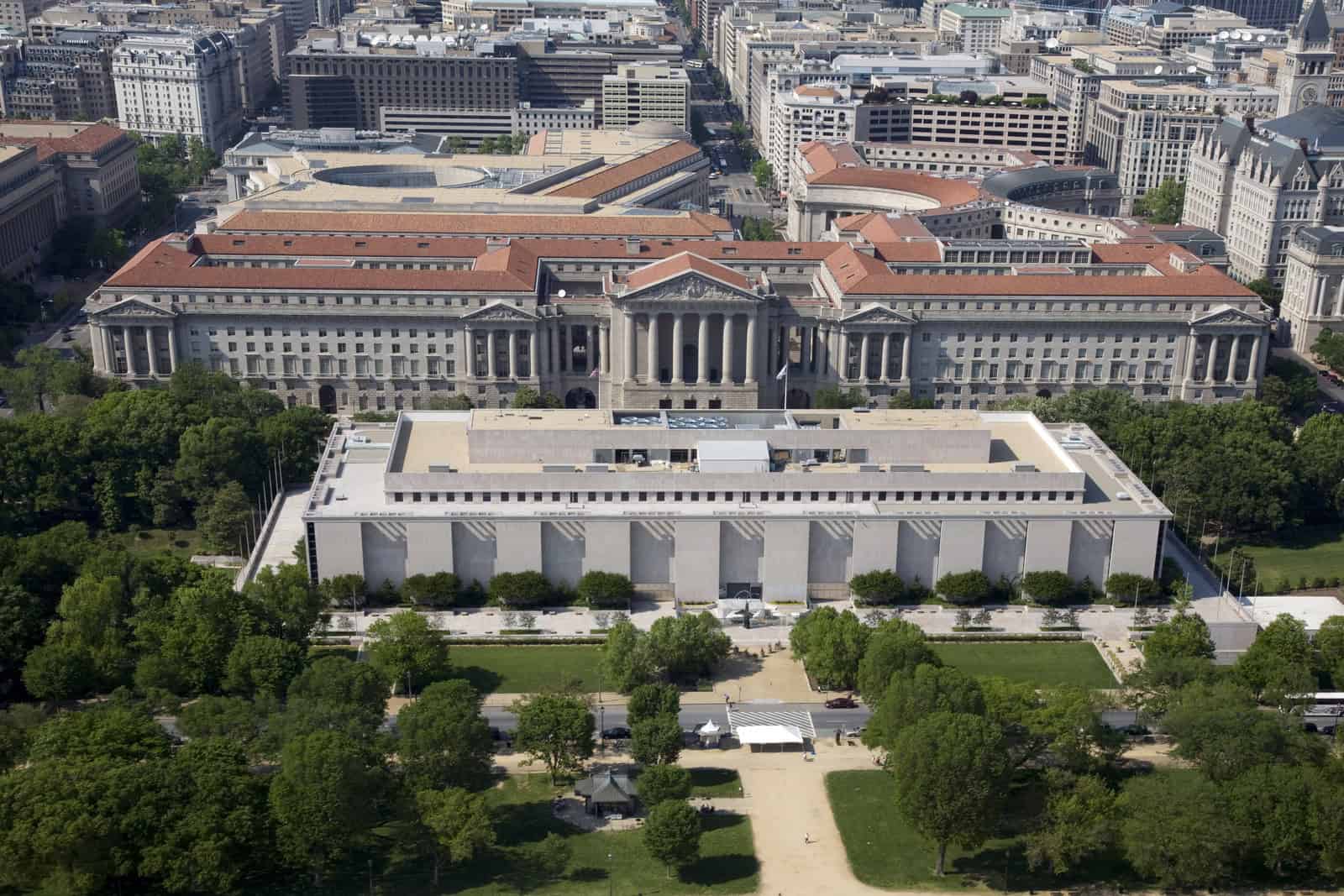
The National Museum of American History in Washington, D.C., photographed by Carol M. Highsmith. Via Wikimedia Commons, public domain.
Indirect Leverage Without an Executed Cutoff
The August 28 document applies indirect pressure through executive-agency support and asks the Board of Regents to intervene, but it records no executed cutoff and does not cancel the Smithsonian’s FY2026 congressional appropriation.

Isabella studied at the University of Cape Town in South Africa and graduated with a Bachelor of Arts majoring in English Literature & Language and Psychology. Throughout her undergraduate years, she took Art History as an additional subject and absolutely loved it. Building on from her art history knowledge that began in high school, art has always been a particular area of fascination for her. From learning about artworks previously unknown to her, or sharpening her existing understanding of specific works, the ability to continue learning within this interesting sphere excites her greatly.
Her focal points of interest in art history encompass profiling specific artists and art movements, as it is these areas where she is able to really dig deep into the rich narrative of the art world. Additionally, she particularly enjoys exploring the different artistic styles of the 20th century, as well as the important impact that female artists have had on the development of art history.
Learn more about Isabella Meyer and the Art in Context Team.
Choose Art in Context as a preferred source to see more of our reporting in Google Top Stories and other Google Search experiences.
Cite this Article
Isabella, Meyer, “Smithsonian Artifact Loans and Grants Threatened: What the Letter Can Reach.” Art in Context. September 3, 2026. URL: https://artincontext.org/smithsonian-artifact-loans-grants-threat-letter/
Meyer, I. (2026, 3 September). Smithsonian Artifact Loans and Grants Threatened: What the Letter Can Reach. Art in Context. https://artincontext.org/smithsonian-artifact-loans-grants-threat-letter/
Meyer, Isabella. “Smithsonian Artifact Loans and Grants Threatened: What the Letter Can Reach.” Art in Context, September 3, 2026. https://artincontext.org/smithsonian-artifact-loans-grants-threat-letter/.


