


Facts About Stonehenge – The Archaeology of Salisbury Plain

Stonehenge may be regarded as among the most well-known monuments in the world, but what is Stonehenge? Why is Stonehenge famous in the first place? We shall explore Stonehenge’s history as well as all the important facts about Stonehenge to help answer these questions.
Exploring the Stonehenge Facts
Every year, more than one million visitors come to experience this ancient structure in Wiltshire, England. Even Charles Darwin paid a visit to this mysterious and captivating monument, in 1877. During what time period was Stonehenge built, though, and why is Stonehenge a mystery? Before we get to the Stonehenge fun facts, let us find out more about Stonehenge’s history.

Stonehenge at a Glance
| Location | Near Amesbury, Wiltshire, England |
| Built | In phases, from around 3,000 BCE to about 1,600 BCE |
| Materials | Local sarsen sandstone; most bluestone from the Preseli Hills, Wales, with the Altar Stone traced instead to northern Scotland |
| Sarsen stone circle | About 33 meters (108 feet) in diameter |
| Earthwork enclosure | About 110 meters (360 feet) in diameter |
| Owner | The state, as part of the National Heritage Collection (surrounding land: largely the National Trust) |
| Managed by | English Heritage |
| Protected status | Scheduled Monument since 1882; UNESCO World Heritage Site, with Avebury, since 1986 |
| Touching the stones | Not allowed on general visits since 1977; booked “Stone Circle Access” visits permit closer approach |
Stonehenge’s History
The fact that Stonehenge is still around for us to admire in the present day is a rather impressive feat itself! Especially considering that construction began around 5,000 years ago.
Around 3,000 BCE, work began on the site to construct an externally-ditched circular earthwork enclosure. It would be used as a kind of communal cemetery to contain the remains of the cremated; the enclosure’s Aubrey Holes probably held timber or stone uprights, and bluestones may also have arrived around this time, though their first setting is uncertain.
The monument was altered several more times over the following centuries; later work included the Y and Z holes, perhaps dug for a rearrangement that was never completed. The main building phases are set out below.
| Phase | Approx. Date | What Changed |
|---|---|---|
| 1 | c. 3,000 BCE | Circular ditch and bank dug; used as a cremation cemetery |
| 2 | c. 2,900-2,600 BCE | Timber structures and posts were erected; bluestones may have arrived earlier, but their first securely described central setting dates to about 2,500 BCE |
| 3 | c. 2,500 BCE | Sarsen circle and horseshoe of trilithons erected and connected by lintels; bluestones set in a double arc between them |
| 4 | c. 2,300-2,200 BCE | Bluestones rearranged to form a circle and inner oval; the Avenue linking the site to the River Avon was built |
| 5 | c. 1,800-1,500 BCE | Y and Z holes dug, perhaps for a further stone rearrangement that was never completed |
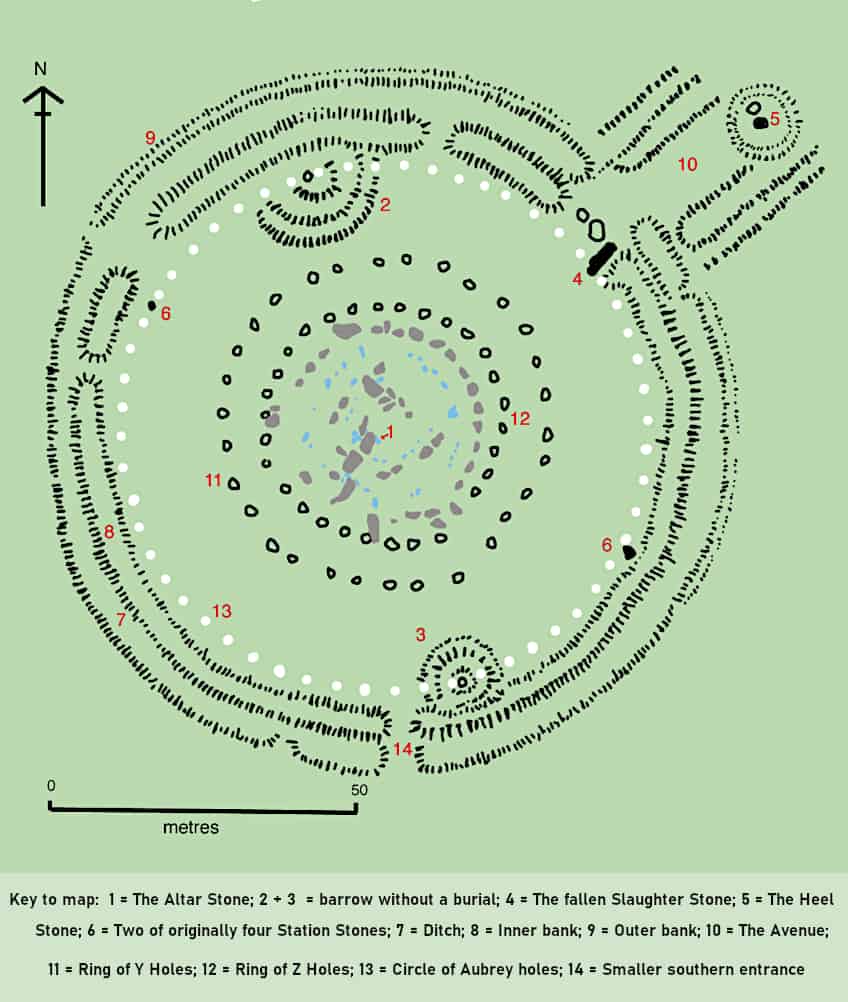
The bluestones were rearranged from a double arc into a circle and an inner oval, which was later altered into a horseshoe. The site had been rearranged many times by 1800 BCE, with carvings etched into the rocks and large pieces broken off and removed.
Dangerous Excavations
Throughout history, there have been many attempts to determine the exact date of Stonehenge’s creation, starting with the Duke of Buckingham, whose men dug into the center of the monument in the 1620s after a visit by King James I. According to the antiquarian William Stukeley’s later account of the dig, the pit turned up only the skulls and horns of oxen and deer, charcoal, and fragments of rusted armor rather than the treasure the Duke had hoped for. These early digs were not kind to the site, and it is believed that the stones became even more unstable due to excavations that took place in the 19th century.
All these interventions eventually led to the collapse of one of the sarsens and its lintel on New Year’s Eve in 1900. This raised safety concerns which led to further excavations in an effort to straighten the stones.
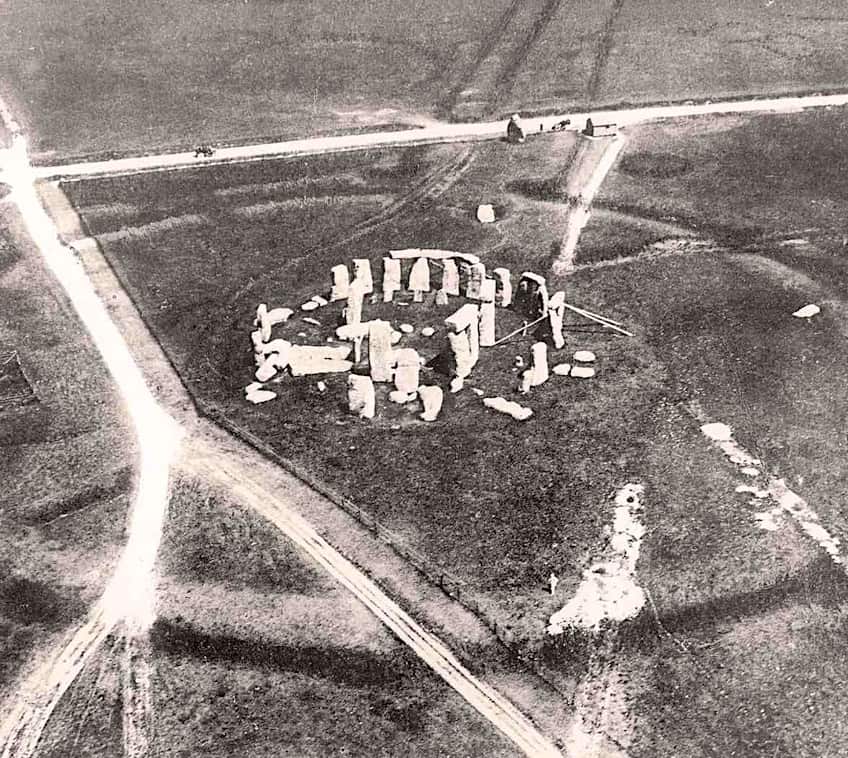
From the 1950s to the mid-1960s, further excavation campaigns were implemented to repair and re-erect many of the stones. While the longevity of the structure was significantly extended by these projects, it would not be until 1995 that the results were released to the public. Further excavations in 2008 revealed that the monument was regularly utilized during the later Roman era. It was also discovered that women, children, and men were all buried at the site between 3000 and 2500 BCE.
Subsequent data published in 2018 also suggested that many of the people buried there were not local; the most plausible origin identified by the researchers was west Wales, the same region from which most of the Welsh bluestones came.

Ownership and Protection Today
Stonehenge remained in private hands for centuries until 1915, when it was sold at auction to a local barrister, Cecil Chubb, for £6,600. Chubb gave the monument to the nation in 1918, and it has been held in public trust ever since. Today, the stones and the ground immediately around them are state-owned as part of the National Heritage Collection, English Heritage looks after the monument day to day, and the National Trust owns much of the surrounding farmland. In 1986, Stonehenge and the nearby Avebury stone circle were jointly inscribed as a UNESCO World Heritage Site. Since 1977, visitors on general admission have not been allowed to walk among or touch the stones, a rule brought in to stop the ground and stone surfaces from eroding further; English Heritage now offers separately booked early-morning and evening “Stone Circle Access” visits for those who want to get closer.
Facts About Stonehenge
How big is Stonehenge, and what was it used for? These are just two of many open questions. The facts below add detail on the site’s past and its uses.
- Stonehenge is an atypical henge. Typical henges feature an internal ditch within a raised earthwork, but at Stonehenge the ditch lies outside the earthwork bank, making it an unusual, early form of the monument type rather than a textbook example. If you want to see a classic henge, there is a well-known one about 20 miles north of Stonehenge called Avebury.
- Where the stones came from is clearer than how they got here. Most of the bluestones were quarried in the Preseli Hills of Wales, roughly 150 miles away, and a few may once have stood in an earlier stone circle there before being moved. The Altar Stone is an exception, having been traced instead to the Orcadian Basin in northern Scotland, over 700 kilometers away. In 2020, geochemical testing traced the origin of most of the sarsens to West Woods in Wiltshire, about 15 miles north of Stonehenge. What is still unresolved is how Neolithic builders moved stones of this size: each sarsen weighs as much as four elephants, and theories involving wooden sledges and rafts remain unproven.

- The construction of Stonehenge coincided with a period of great change. At the time of the building of Stonehenge, metalworking knowledge, Beaker pottery, and certain burial rituals were being brought over from Europe. Beaker graves from around 2400 BCE have been unearthed near the site.
- Astronomers find Stonehenge fascinating. Many astronomers have analyzed the site to try to gain a better understanding of Stonehenge. For example, Dr. Halley tried to work out the site’s age using the position of the rising sun on the horizon and magnetic deviation. Another astronomer, John Smith, noted that if one multiplied the number of astrological signs by the number of stones at Stonehenge, then the result would be the number of days in the year. The site has a well-established solstitial alignment: on the morning of the summer solstice, the sun can be observed rising near the Heelstone, and at the winter solstice it sets in the opposite direction. There is no evidence that Stonehenge marked the equinoxes. Some researchers also point to possible lunar alignments among the Station Stones, though their intentional use for ceremony or agriculture remains debated.

- The Romans once occupied the site. During excavation carried out at various periods at the site, Roman coins, metal objects, and pottery have been unearthed. The quantity of Roman material suggests the site saw substantial activity in this period rather than casual visits; far fewer finds date from the Middle Ages.
- Darwin’s dig at Stonehenge was about earthworms, not treasure. In 1877, he dug two small test holes beside fallen sarsens to study how earthworm burrowing gradually buries objects lying on the surface. The findings proved useful to archaeologists: objects found at lower levels were not necessarily older, since worm activity could cause more recent items to sink over time.

- Many of the standing stones have been straightened or re-erected. Although we may regard Stonehenge with a certain amount of awe considering how long it has existed in the same spot, the truth is that it has been significantly restored over the years. A stone that was leaning was placed in concrete and set straight as far back as 1901. A further six stones were straightened and re-erected in 1920, during restoration work carried out by the Society of Antiquaries. From 1958 to 1964, several more stones were moved and re-erected. Although prehistoric rearrangement, loss and this modern restoration complicate the picture, excavated stoneholes and recorded interventions allow archaeologists to reconstruct much of the monument’s building sequence and likely layouts.
- The Construction of Stonehenge is said to be attributed to King Arthur’s mage. Well, at least in an old myth, that is. According to this myth, Merlin advised King Aurelius Ambrosius to fetch the Giants’ Ring from Mount Killaraus in Ireland, a circle giants were said to have carried there from Africa. When Uther Pendragon’s men could not shift the stones, Merlin used his own arts to dismantle the ring and set it up again on Salisbury Plain.

- Some Stonehenge bluestones may be “Ringing Rocks”. This is due to the fact that, if struck, they emit a bell-like ringing sound. The effect has been documented in the Preseli bluestones: testing on Carn Menyn found that between 5 and 20 percent of the rocks ring when struck, and researchers have suggested the stones may have been chosen partly for that property.
- The earliest known realistic representation of Stonehenge was done by Lucas de Heere. It was produced on site using watercolors in a sketchbook between 1573 and 1575 and reflects this Flemish author and artist’s project of creating an accurate record of the ethnography, geography, and history of England.

- In 1923, the remains of a man that had been decapitated was found at the site during excavation. Dating back to the 7th century CE, his body was unearthed from one of the pits within the stone circle. Buried without grave goods in a shallow pit too short for his body, he was around 28 to 32 years old at the time of his death. This discovery reveals that the site had been used long after it was originally constructed. It also suggests that Stonehenge may have been used for ceremonial or ritual purposes. The head, only partially severed, had been pushed forward onto the chest when the body was forced into the undersized pit. Theories around why he was decapitated range from ritualistic purposes to criminal execution.
- Hippies and police got into a violent confrontation near Stonehenge in 1985. On the 1st of June, 1985, a large group of New Age travelers was on their way to a summer solstice festival that was being held at Stonehenge. A few miles before the site, police had set up a blockade and were not allowing anyone to pass. This eventually led to an extreme amount of violence inflicted upon the travelers by the police who attacked the crowds with dogs, shields, and truncheons. Many were seriously hurt and vehicles suffered significant damage. Travellers brought a civil action against Wiltshire Police, and in 1991, 21 of them were awarded around £24,000 in damages for false imprisonment, wrongful arrest, and property damage. One Wiltshire Police sergeant was later convicted of assault occasioning actual bodily harm arising from the confrontation. Known as the Battle of the Beanfield, it is regarded as a turning point in the manner in which police dealt with these kinds of visitors.

A Few Stonehenge Fun Facts
A few lesser-known aspects round out the picture. Why is Stonehenge still a mystery to historians, and will we ever know the whole story? Given how many times it was rebuilt over the centuries, is there even a single point at which it was “finished”?
- There are several prehistoric circular monuments in the area. This includes Avebury and the timber circles at Durrington Walls. Avebury is around 20 miles from Stonehenge itself and is often described as the largest stone circle in the world, though unlike Stonehenge, whose large sarsens have been traced to a single source at West Woods, Avebury’s sarsens appear to have been gathered from several sources nearer at hand. Durrington Walls, which is believed to have been a ceremonial site, is located only two miles to the North of Stonehenge, and its circles were built of timber rather than stone. All three sites fall under the banner of the Stonehenge Heritage Site.

- A hundred years before the Battle of the Beanfield, visitors were also kept out. In 1885, there was a slew of angry letters posted to various publications regarding the regular vandalism afflicted upon the site and stones. Chunks of the stone were often cut off by local people who would then sell them as souvenirs to visitors. A group of people was sent out to assess the damage – included in the group rather ironically were several archeologists who had done their fair share of unauthorized picking and removing of the stones. A barbed wire fence was eventually installed in 1901 to deter further damage.
- Several features at the site are still unexcavated. As with many ancient monuments that have been discovered, many parts of the huge Stonehenge complex have yet to be uncovered. There are many structures at Stonehenge that are still buried underground which could reveal much about the use of the site. The Stonehenge Cursus, a roughly 2.7-kilometre-long rectangular earthwork enclosure bounded by parallel ditches and banks, is one of the structures that have been discovered. It is believed to have originally been used for ceremonial purposes.

Frequently Asked Questions
What was Stonehenge’s Purpose?
We still do not know exactly why Stonehenge was built, but there are many theories that have been postulated. One long-standing theory is that Stonehenge’s solstitial alignment had a calendrical significance, though its exact purpose and any agricultural function remain uncertain. A more recent theory is that the site was one of two connected monuments: an annual commemoration of the dead at Stonehenge and a celebration of the living at nearby timber monuments including Durrington Walls and Woodhenge. Isotope evidence from animals consumed at Durrington Walls suggests that feast participants came from across Britain, though it does not establish attendance from Western Europe. Modern New Age travelers associate the site with pagan and druidic beliefs, such as the celebration of certain natural annual occurrences such as equinoxes. However, it is now generally accepted that the site was used for different purposes throughout the centuries.
Why Is Stonehenge Famous?
It is no real surprise that Stonehenge is a popular destination. Due to its ancient origins and connection to the stars, it carries with it a certain mystical appeal that speaks to many people. Because of its well-established alignment with the sun at the solstices, and possible, debated lunar links, it is a kind of mecca for New Age travelers whose beliefs are connected to events in nature. There are also many legends associated with the site, such as the myth about Merlin moving the stones from Ireland.
How Big Is Stonehenge?
It depends which part of the site you mean. The ring of sarsen stones itself is about 33 meters (108 feet) across. That stone circle sits inside a much larger circular earthwork, a ditch and bank enclosure roughly 110 meters (360 feet) in diameter, which is often what visitors picture as “Stonehenge.” The wider protected landscape around the monument, part of a UNESCO World Heritage Site shared with Avebury, covers more than 26 square kilometers (10 square miles).
How Long Did It Take to Build Stonehenge?
Building took place on and off for around 1,500 years, not continuously but in several distinct bursts of activity. The earliest earthwork enclosure was dug around 3,000 BCE, the sarsen circle and trilithons familiar today were raised around 2,500 BCE, and later work, including the digging of the Y and Z holes, continued until about 1,500 BCE, though the last securely dated bluestone rearrangement took place around 2,300-2,200 BCE. Long gaps, sometimes centuries, separated these phases, meaning many generations worked on the monument without any of them seeing it in its current form.
Why Is Stonehenge a Mystery?
Although there are many theories surrounding the site, there is not much that can be ascertained for definite. We still do not fully understand why the structure was built, nor do we know for sure what it was potentially used for. The solstitial alignment offers a clue, and shows how closely the Neolithic and Bronze Age builders tracked the sun’s annual cycle; other proposed astronomical links, including to the moon and stars, remain more uncertain.

Justin van Huyssteen is a freelance writer, novelist, and academic originally from Cape Town, South Africa. At present, he has a bachelor’s degree in English and literary theory and an honor’s degree in literary theory. He is currently working towards his master’s degree in literary theory with a focus on animal studies, critical theory, and semiotics within literature. As a novelist and freelancer, he often writes under the pen name L.C. Lupus.
Justin’s preferred literary movements include modern and postmodern literature with literary fiction and genre fiction like sci-fi, post-apocalyptic, and horror being of particular interest. His academia extends to his interest in prose and narratology. He enjoys analyzing a variety of mediums through a literary lens, such as graphic novels, film, and video games.
Justin is working for artincontext.org as an author and content writer since 2022. He is responsible for all blog posts about architecture, literature and poetry.
Learn more about Justin van Huyssteen and the Art in Context Team.
Cite this Article
Justin, van Huyssteen, “Facts About Stonehenge – The Archaeology of Salisbury Plain.” Art in Context. July 20, 2023. URL: https://artincontext.org/facts-about-stonehenge/
van Huyssteen, J. (2023, 20 July). Facts About Stonehenge – The Archaeology of Salisbury Plain. Art in Context. https://artincontext.org/facts-about-stonehenge/
van Huyssteen, Justin. “Facts About Stonehenge – The Archaeology of Salisbury Plain.” Art in Context, July 20, 2023. https://artincontext.org/facts-about-stonehenge/.