

Sotheby’s $450 Million Blaquier-Arrieta Sale: What the Estimates Really Mean

Sotheby’s has unveiled twelve Impressionist and modern works from the Blaquier-Arrieta collection ahead of a November 18 New York auction carrying an announced aggregate estimate of about $450 million. That figure is an expectation, not a result—and the lot-level numbers published so far do not add up to one exact $450 million total.
Twelve Works, but Not Twelve Published Estimates
Sotheby’s unveiled the 12-work collection on September 30, with a selection placed on view in London. The Associated Press reported that the children of Argentine collectors Nelly Arrieta de Blaquier and Carlos Pedro Blaquier are selling the works, with the single-owner auction scheduled for November 18 in New York. A tour is also planned through Taipei, Hong Kong and Paris before the sale.
The selection reads like a compact survey of late-19th- and early-20th-century French art: Van Gogh and Cézanne at the top, followed by Renoir, Pissarro, Degas, Monet, Gauguin, Sisley, Toulouse-Lautrec, Derain and Vlaminck. Nelly Arrieta, who died in 2020, led the Friends of the Museo Nacional de Bellas Artes in Buenos Aires from 1977 to 2011; Le Journal des Arts reports that the couple’s larger collection also included Argentine and Latin American art that remains in Argentina.
The leading Van Gogh, Châtaigniers en fleurs (1890), is a 70-by-58-centimeter Auvers landscape dominated by a flowering chestnut tree. Its May date places it inside the final Auvers chapter of Vincent van Gogh’s life, while its compressed street view and charged brushwork make it a concentrated example of Van Gogh’s late style. The Blaquiers reportedly bought it from Wildenstein in 1975, after an ownership chain that included Theo van Gogh, Johanna van Gogh-Bonger, publisher Samuel Fischer, songwriter and producer Buddy DeSylva, and collector Harriet Harris-Jonas.
A twelve-lot inventory published by Infobae supplies the fullest announcement-day breakdown. Eight works have a quoted figure or range; four are named without one.
| Work | Reported estimate |
|---|---|
| Van Gogh, Châtaigniers en fleurs | About $180M |
| Cézanne, Arlequin | About $120M |
| Pissarro, Place du Théâtre-Français… | $30M–$40M |
| Renoir, En canot | $25M–$35M |
| Degas, Avant la course | $20M–$30M |
| Monet, Le Jardin des Tuileries | $15M–$20M |
| Gauguin, Fleurs dans une coupe | $10M–$15M |
| Derain, Bateaux au port de Collioure | $8M–$12M |
| Vlaminck, Nature morte à la cruche bleue | Not stated |
| Sisley, La Seine à Port-Marly | Not stated |
| Pissarro, Maison de Piette à Montfoucault | Not stated |
| Toulouse-Lautrec, Femme assise de profil… | Not stated |
The arithmetic exposes an important limit in the headline number. Treating the two “about” figures as $180 million and $120 million, then adding the low ends of the six disclosed ranges, produces $408 million. Adding their high ends produces $452 million—before assigning any value to the remaining four works. The $450 million should therefore be read as a rounded aggregate expectation, not a precise lot-by-lot total that can yet be reconstructed from the public figures.

The Van Gogh Record Case Is Stronger Than Cézanne’s
The current public-auction records for both artists came from the Paul G. Allen collection at Christie’s in New York in November 2022. Christie’s published results put Van Gogh’s Verger avec cyprès at $117.18 million and Cézanne’s La Montagne Sainte-Victoire at $137.79 million.
On a face-value comparison, the Van Gogh’s $180 million expectation stands $62.82 million, or 53.6 percent, above the existing record. The Cézanne’s roughly $120 million figure sits $17.79 million, or 12.9 percent, below its artist record. Those comparisons are directionally useful but not like-for-like: Sotheby’s says its estimates exclude the buyer’s premium, while published auction results customarily include it.
Under Sotheby’s current New York premium schedule, a $120 million hammer price would carry a $560,000 premium on the first $2 million, $1.32 million on the next $6 million and $16.8 million above $8 million. The resulting $138.68 million price, before tax, would exceed Cézanne’s record by only $890,000, or about 0.6 percent. A $180 million hammer for the Van Gogh would translate to about $207.68 million under the same schedule, roughly 77 percent above the existing record.
That is the central distinction obscured by a shared “record” label. Van Gogh could fall well short of $180 million at the hammer and still set a new auction high. Cézanne would need to land close to the quoted expectation, with the premium doing the final work, merely to edge past the Allen result.
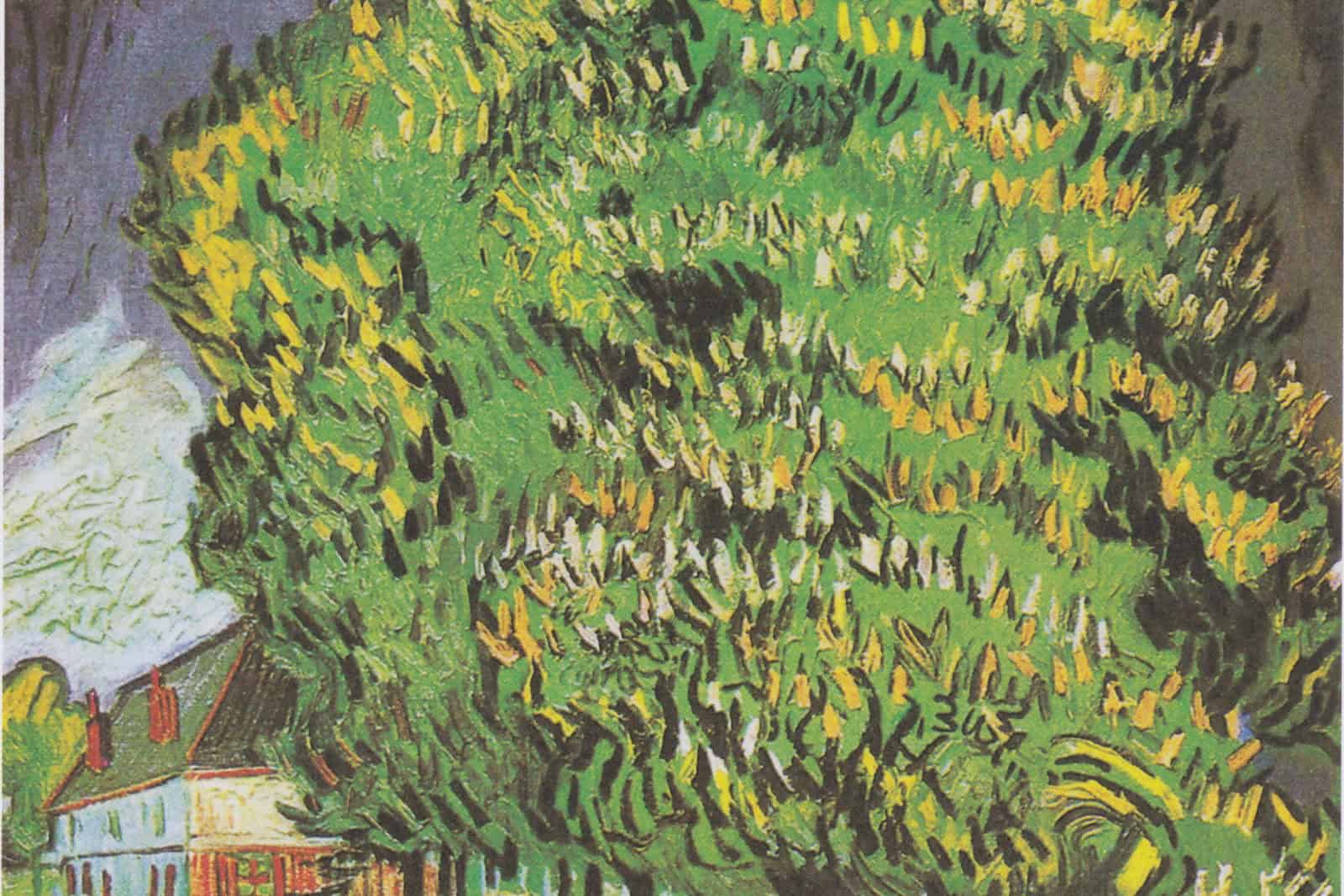
Vincent van Gogh, Chestnut Trees in Blossom, May 1890, the leading work in the Blaquier-Arrieta sale. Wikimedia Commons, Public Domain Mark 1.0.
Why the Fifty-Year Absence Matters
The two top works have not been publicly exhibited since 1975, according to Sotheby’s information reported by AP and Infobae. For the Van Gogh, that date is also when the Blaquiers acquired it. For Cézanne’s Arlequin, the earlier exhibition history is unusually substantial: it was shown at MoMA’s inaugural 1929 exhibition, at the Art Institute of Chicago in 1952 and at Tate in 1954.
Cézanne painted his son Paul in four large Harlequin compositions between 1888 and 1890. The auction picture is reportedly the only one of those four still in private hands. The National Gallery of Art canvas shown below is a related work from that group, not the Blaquier-Arrieta painting; its presence in a public collection clarifies why the private example is being presented as a museum-level opportunity.
Long absence can create scarcity, but it does not itself prove value or condition. What can be established is more specific: neither leading picture has a public-auction history, both have long documented ownership chains, and the Cézanne brings an exhibition history tied to major museums. The November bidding will price that combination of rarity, provenance and visibility for the first time in a public room.
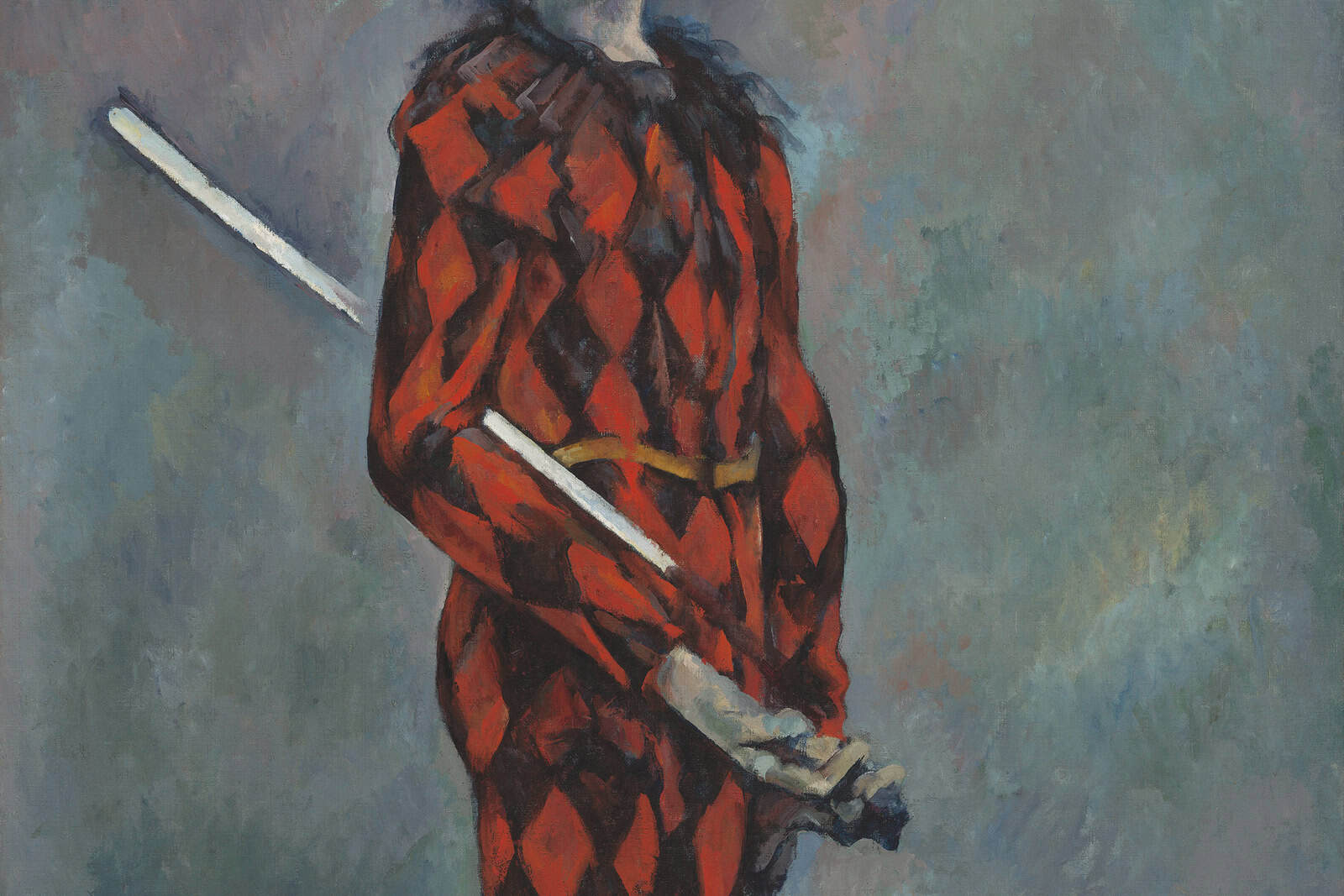
Paul Cézanne, Harlequin, 1888–1890, National Gallery of Art; this is a related composition, not the Blaquier-Arrieta painting. Wikimedia Commons, CC0 1.0 Universal Public Domain Dedication.
The Guarantee Question Changes the Market Test
Estimates remain unpublished for four works, while guarantee and irrevocable-bid designations may appear on lot pages, the auction page or in saleroom announcements before the sale. Artnet reported in August, citing several market sources, that Sotheby’s won the consignment with a large guarantee; Sotheby’s declined to comment. On September 30, former Christie’s specialist Thomas Seydoux told Le Journal des Arts that he believed guarantee terms reflected competition between auction houses as much as the works’ value. These are attributed market reports, not confirmed lot terms.
Sotheby’s own catalog symbol guide says a house guarantee promises the seller a minimum price regardless of the auction outcome and gives Sotheby’s a direct financial interest. An irrevocable bid, disclosed with a different symbol, ensures that a lot will sell and may shift part of the risk to a third party.
A guaranteed collection can still generate genuine competition and records. But a 100-percent sell-through rate would not, by itself, prove that twelve independent buyers met twelve unprotected reserves. The stronger public evidence will be the lot symbols, hammer prices relative to estimates and any bidding above disclosed irrevocable bids; the symbols identify protected lots but not the guarantee amounts.

Pierre-Auguste Renoir, En canot (Jeune fille à la barque), 1877, via Wikimedia Commons, Public Domain Mark 1.0. Cropped.
What the Announcement Establishes
- The November 18 sale comprises twelve named works, not an unspecified tranche; AP and the announcement-day inventory identify every artist and title.
- The published estimates do not yet reproduce one exact $450 million sum: eight disclosed figures span $408 million to $452 million before four unpriced works are counted.
- Christie’s results make Van Gogh’s record case substantial, while Sotheby’s current premium schedule shows that a $120 million Cézanne hammer would clear the existing record by less than $1 million.
- Guarantee reporting remains attributed to market sources; Sotheby’s catalog symbols will determine how much of the sale is protected before bidding begins.

Isabella studied at the University of Cape Town in South Africa and graduated with a Bachelor of Arts majoring in English Literature & Language and Psychology. Throughout her undergraduate years, she took Art History as an additional subject and absolutely loved it. Building on from her art history knowledge that began in high school, art has always been a particular area of fascination for her. From learning about artworks previously unknown to her, or sharpening her existing understanding of specific works, the ability to continue learning within this interesting sphere excites her greatly.
Her focal points of interest in art history encompass profiling specific artists and art movements, as it is these areas where she is able to really dig deep into the rich narrative of the art world. Additionally, she particularly enjoys exploring the different artistic styles of the 20th century, as well as the important impact that female artists have had on the development of art history.
Learn more about Isabella Meyer and the Art in Context Team.
Choose Art in Context as a preferred source to see more of our reporting in Google Top Stories and other Google Search experiences.
Cite this Article
Isabella, Meyer, “Sotheby’s $450 Million Blaquier-Arrieta Sale: What the Estimates Really Mean.” Art in Context. September 30, 2026. URL: https://artincontext.org/blaquier-arrieta-collection-sothebys-auction-2026/
Meyer, I. (2026, 30 September). Sotheby’s $450 Million Blaquier-Arrieta Sale: What the Estimates Really Mean. Art in Context. https://artincontext.org/blaquier-arrieta-collection-sothebys-auction-2026/
Meyer, Isabella. “Sotheby’s $450 Million Blaquier-Arrieta Sale: What the Estimates Really Mean.” Art in Context, September 30, 2026. https://artincontext.org/blaquier-arrieta-collection-sothebys-auction-2026/.


