


Three Church Artworks Reported Stolen in Valladolid

Three devotional artworks have been reported stolen from two churches in Valladolid, Spain: a small Ecce Homo painting, a polychrome wooden angel, and a silver-colored Via Crucis station. The third loss emerged four days after the first police reports, turning a pair of suspected thefts into a broader test of how working churches document art that remains in daily religious use.
Three Missing Works in Two Valladolid Churches
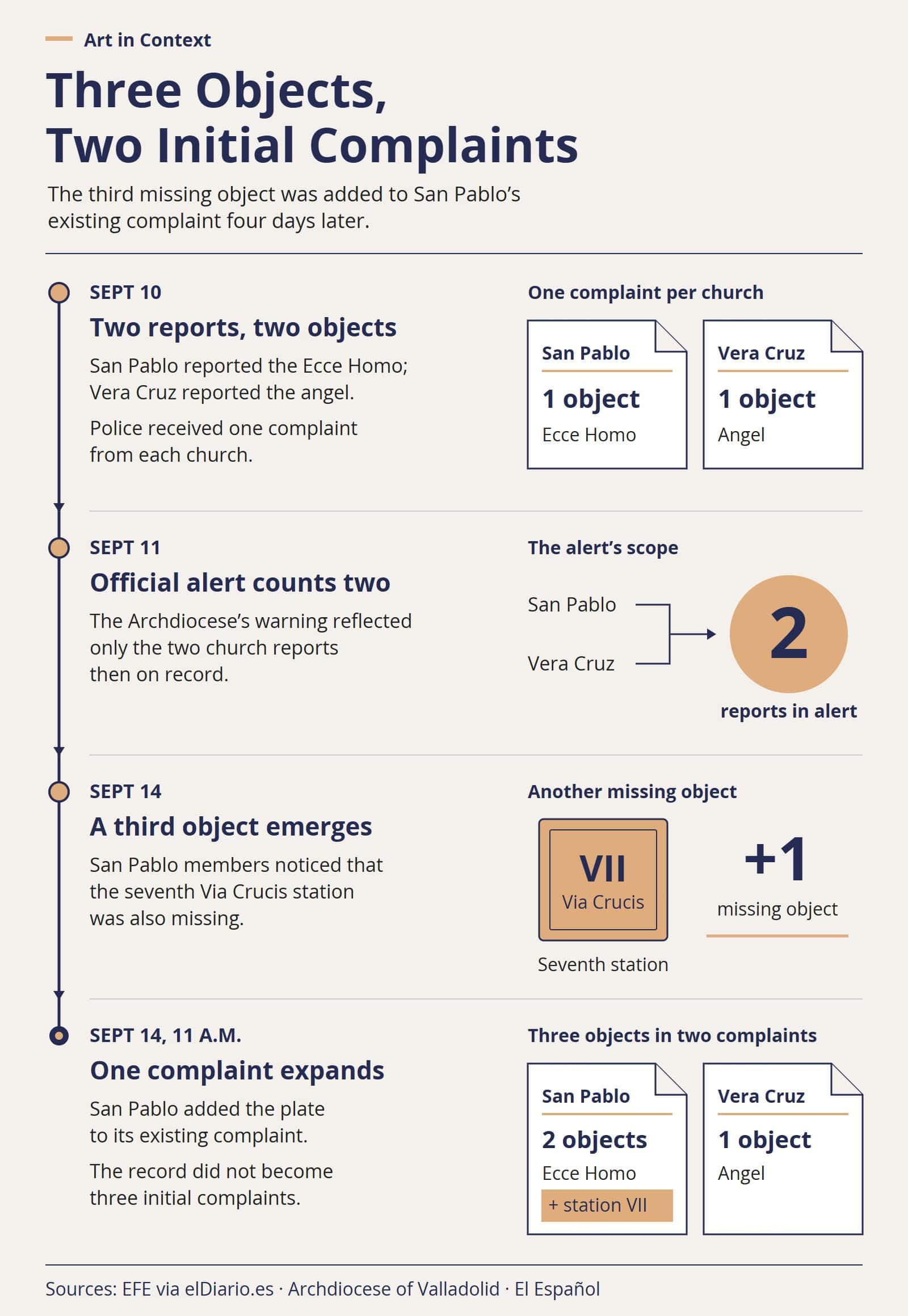
The losses concern the Conventual Church of San Pablo and the Penitential Church of Santa Vera Cruz, two active churches in central Valladolid located roughly a quarter-mile apart. Police were initially investigating two possible thefts. By September 14, San Pablo had added a second missing object to its complaint.
| Work and site | Reported description | Discovery timeline |
|---|---|---|
| Ecce Homo, San Pablo | Small painting copying a composition by Luis de Morales; reports disagree between the 17th and 18th centuries | Noticed missing during the 8:30 p.m. Mass on September 10; reported that night |
| VII Station of the Cross, San Pablo | About 12 inches high; El País describes a silver relief of Christ’s second fall, while the congregation called the plate silver-colored | Noticed by September 14; added to San Pablo’s existing complaint that morning |
| Torch-bearing angel, Vera Cruz | Polychrome wood carving, about 24 to 26 inches high; reported as either 17th- or 18th-century | Found missing after evening services on September 10; separately reported that night |
An EFE dispatch carried by elDiario.es reported that the Subdelegation of the Spanish government confirmed two complaints late on September 10, one from each church. The prior of San Pablo told EFE that the Ecce Homo disappeared during Mass; witnesses later told him that a man lowered the painting, put it in a plastic bag, and walked out. That account is testimony relayed through the prior, not a police finding.
At Vera Cruz, the exact time of removal remains unknown. Alfonso Domínguez of the cofraternity told EFE that there were no signs of force. The missing angel was one of a pair flanking the altar of the Lignum Crucis, so its removal broke a devotional ensemble rather than simply emptying a display case.
The Works Do Not Share a Settled Date
The early coverage gives the three objects a tidier chronology than the available documentation supports. Europa Press described the first two losses as 17th-century works. EFE called both the angel and the Ecce Homo copy 18th century. El País dated the painting copy to the 17th century and identified the angel in its photograph caption as 17th century. The Archdiocese’s September 11 notice did not date or individually describe either object.
The cofraternity labels its Lignum Crucis entry “Anonymous, about 1500–1550” but separately dates the silver, gilded-bronze, and gemstone ostensorium housing the relic to the 17th century. That does not date the flanking angel, whose century should be treated as reported dating.
The painting requires a second distinction. EFE and El País describe the stolen painting as a later copy after Luis de Morales, while El Debate calls it a work by Morales. In catalogue language, “after Luis de Morales” preserves that difference between a prototype and a later copy. Its attribution, dimensions, support, and exact date have not been published in the available custodial record.
The Via Crucis station is more recent as a news development, but not better documented as an object. September 15 reporting describes a roughly 30-centimeter panel with a silver relief showing the seventh station, Christ falling for the second time. The San Pablo congregation told El Español only that the plate was silver-colored. Those descriptions should not be collapsed into a confirmed statement that the metal itself is silver.

The Lignum Crucis reliquary at Vera Cruz, whose altar was flanked by the missing angel. Photograph by Laci3, via Wikimedia Commons, under the Creative Commons CC0 1.0 Universal Public Domain Dedication.
Why an Official Alert Still Refers to Two Thefts
The apparent mismatch between two and three is chronological. The Archdiocese issued its alert on September 11, after the Ecce Homo and angel had been reported. San Pablo noticed the missing Via Crucis station by September 14 and expanded its earlier complaint, according to El Español. The public record therefore supports three missing objects, two initial complaints, and a later enlargement of one complaint—not necessarily three separate police complaints.
The same timeline also limits any theory of a single offender. El País noted the churches’ proximity and the short interval as reasons to consider a common perpetrator, while San Pablo’s prior suspected that its two objects disappeared during the same Mass. Police had announced no conclusion on either point by September 15. A shared perpetrator remains a possibility, not an established link.
The reports by El País, EFE, Europa Press, and El Español supply no valuation for any of the objects, and none had been reported recovered by the afternoon of September 15. Their significance does not depend only on price: the angel formed part of an altar arrangement, the Via Crucis panel belonged to a devotional sequence, and the Ecce Homo occupied a side chapel. Each loss changes a still-functioning visual and ritual setting.
What a Photographed Inventory Can—and Cannot—Do
The Archdiocese’s official notice asked churches across the archdiocese to increase precautions and surveillance, maintain current inventories with photographs where possible, and report losses quickly. The call preceded discovery of the third missing object, but that discovery makes its practical point sharper: a removal cannot be reported until someone knows what should be in a specific location.
A photograph is not a substitute for physical security. It does, however, make an object more identifiable after a theft. Spain’s Guardia Civil advises custodians to keep a photograph in a secure place and record measurements, inscriptions, marks, distinguishing characteristics, subject, period, and maker. INTERPOL’s Object ID standard asks for the same core data so police, customs agencies, cultural institutions, and the art trade can exchange descriptions.
That distinction matters here. The published descriptions already vary on century, size, and whether one component is silver or merely silver-colored. A dated image tied to dimensions and material notes would let investigators circulate a stable description without turning an early news label into permanent provenance. This is part of curatorial work even when the collection belongs to a church rather than a museum.
The two churches also illustrate why inventories and surveillance address different vulnerabilities. The San Pablo account places a portable painting in a remote side chapel while worshippers faced forward. At Vera Cruz, the angel formed part of an altar ensemble, yet its absence was discovered only after services. Documentation improves identification and recovery; sightlines, staffing, fixings, alarms, and cameras concern prevention. Neither the Archdiocese nor police have publicly detailed which physical measures will change.
Valladolid’s losses arrive amid a separate debate over Spain’s museum security response after gold and coin thefts. The comparison has limits. Unlike many museum objects, these works remained in spaces organized for worship and public access, where the value of the art includes its relationship to a sequence, altar, and community practice.

Inside San Pablo, where an Ecce Homo painting and a Via Crucis station were reported missing. Photograph by Jose Luis Filpo Cabana, via Wikimedia Commons, under CC BY 3.0.
Three Objects Missing, With Key Details Unsettled
The record now establishes three missing devotional objects across two churches: two at San Pablo and one at Vera Cruz.
The common-offender theory remains unconfirmed, and the reporting does not settle the works’ dates or prove that the Via Crucis relief is made of silver.

Isabella studied at the University of Cape Town in South Africa and graduated with a Bachelor of Arts majoring in English Literature & Language and Psychology. Throughout her undergraduate years, she took Art History as an additional subject and absolutely loved it. Building on from her art history knowledge that began in high school, art has always been a particular area of fascination for her. From learning about artworks previously unknown to her, or sharpening her existing understanding of specific works, the ability to continue learning within this interesting sphere excites her greatly.
Her focal points of interest in art history encompass profiling specific artists and art movements, as it is these areas where she is able to really dig deep into the rich narrative of the art world. Additionally, she particularly enjoys exploring the different artistic styles of the 20th century, as well as the important impact that female artists have had on the development of art history.
Learn more about Isabella Meyer and the Art in Context Team.
Choose Art in Context as a preferred source to see more of our reporting in Google Top Stories and other Google Search experiences.
Cite this Article
Isabella, Meyer, “Three Church Artworks Reported Stolen in Valladolid.” Art in Context. September 15, 2026. URL: https://artincontext.org/valladolid-church-art-thefts-three-works-2026/
Meyer, I. (2026, 15 September). Three Church Artworks Reported Stolen in Valladolid. Art in Context. https://artincontext.org/valladolid-church-art-thefts-three-works-2026/
Meyer, Isabella. “Three Church Artworks Reported Stolen in Valladolid.” Art in Context, September 15, 2026. https://artincontext.org/valladolid-church-art-thefts-three-works-2026/.


