

Sliman Mansour, Palestinian Painter of Jamal al-Mahamel, Dies at 79

Sliman Mansour, the Palestinian painter whose Jamal al-Mahamel is among the most recognized images in modern Arab art, died in Jerusalem on Monday, August 24, 2026, at the age of 79. His family announced the death on Instagram and has not disclosed a cause. The painting that carries his reputation is not one canvas but three, painted across thirty-two years.
Jamal al-Mahamel Is Three Paintings, Not One
Mansour painted the old porter with Jerusalem strapped to his back in Birzeit, the West Bank town where he was born. Hyperallergic’s obituary dates that canvas to 1973 and records it as oil on canvas, 28 by 41 1/2 inches. It became the image that traveled on posters, book jackets and living-room walls across the Arab world, and The National this week called it “perhaps his most recognisable work.”
Neither Hyperallergic’s obituary nor The National’s survey of seven Mansour paintings mentions that he painted the composition three separate times.
Anna Seaman, reporting for The National in March 2015, set out the sequence: a first version painted in 1973, a second in 1975, and a third in 2005. The 1975 canvas, she wrote, “was believed to have been destroyed in 1986.” Writing the following year in MERIP, Dina Ramadan reported that the destroyed canvas had belonged to Muammar Qaddafi and was lost when the United States bombed his Tripoli compound in 1986.
| Version | Painted | Status |
|---|---|---|
| First | 1973 | Owned by a London-based collector in 2015; current location not publicly confirmed |
| Second | 1975 (1976 per Al Jazeera Arabic) | Believed destroyed, 1986 |
| Third | 2005 | Sold at auction, 2015 |
The third canvas produced an auction-house correction. Christie’s announced the work for its Dubai sale as Jamal al-Mahamel II. A London-based collector saw the catalogue online and came forward to say the 1973 original was in his possession, which made the lot the third version rather than the second. Christie’s re-catalogued it. The National reported that the estimate had been reduced to $50,000 to $60,000, while Christie’s final results list an estimate of $60,000 to $90,000. The painting ultimately sold for $257,000 to the Palestinian economist and collector Ramzi Dalloul.
Which Year Belongs on the Label
The sources do not agree. Hyperallergic gives 1973 for the first canvas. The encyclopedia of Mathaf, the Arab Museum of Modern Art in Doha, gives 1974 for the work it lists as Camel of Hardship. Two independent reports built around the 2015 sale, Seaman’s and Ramadan’s, both place the first version in 1973. That is the better-supported date.
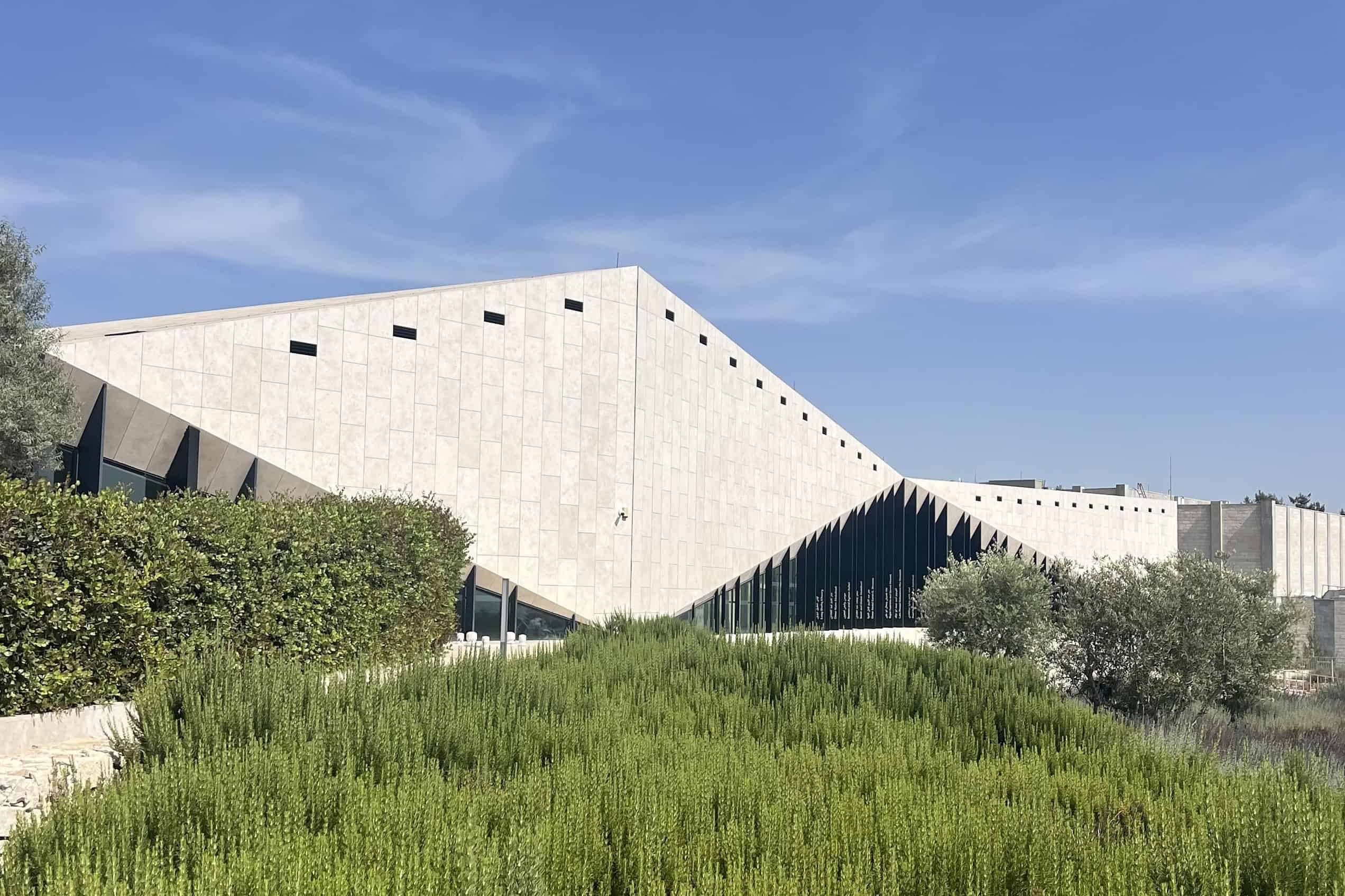
The Palestinian Museum in Birzeit, the West Bank town where Sliman Mansour was born and where his funeral is to be held. The museum holds his work. Photo by Dan Palraz, via Wikimedia Commons, licensed under Creative Commons Attribution-Share Alike 4.0 International. Cropped.
He Studied at Bezalel in Jerusalem

Sliman Mansour at the Palestine International Book Fair, September 2023. Photo by Wiki Palestine, via Wikimedia Commons, licensed under Creative Commons Attribution-Share Alike 3.0 Unported. Cropped.
Mathaf gives his birth date as July 27, 1947, in Birzeit. He had turned 79 four weeks before he died.
Mathaf’s entry states that he “studied fine arts at Bezalel Art Academy in Jerusalem.” The National’s obituary goes further and says he graduated from the Bezalel Academy of Arts and Design in 1970.
Mansour’s Bezalel training adds an important complication to his biography. The National says he graduated in 1970, while Jerusalem Story says he left that year without a degree because he could not afford the tuition. Bezalel’s own institutional timeline states that it did not begin awarding bachelor’s degrees until 1975. What is securely established is that Mansour studied there from 1967 to 1970.
Al Jazeera’s obituary describes his training differently, saying he studied art in Beirut and Washington. These accounts are not necessarily mutually exclusive, but the available records consistently place Mansour at Bezalel in Jerusalem from 1967 to 1970. Whether he formally graduated remains unclear.
Mud Was a Formal Decision, Not Only a Political Gesture
During the First Intifada, Mansour formed the collective New Visions with Vera Tamari, Tayseer Barakat and Nabil Anani. Mathaf dates the group’s formation to 1987, while The Palestinian Museum gives 1989, the year associated with its documented public presentation. The discrepancy may reflect the difference between the artists beginning to work collectively and the group becoming formally identifiable as New Visions. Mathaf’s record and Mansour’s own biography name the same four founders and the same year. The group stopped buying Israeli-manufactured art supplies and worked instead with what the ground provided: mud, straw, wood, leather, henna and natural dyes.
The boycott is normally told as a political act, and it was one. Its consequences were formal.
Oil on canvas holds still. Mud does not. The National describes Mansour layering and molding mud over wooden armatures and letting it crack as it dried, which means the fracture pattern is produced by the material rather than drawn by the artist. Mathaf records that critics came to call the resulting works “emblems of decay.”
The distance between that and his earlier practice is a distance in kind. The 1970s paintings were symbolist figuration: a porter, a load, a city, each element placed to be decoded. The mud works dispense with the need for a symbol, because the material is already the statement. A surface of Palestinian earth that splits as it dries does not depict attrition; it undergoes it, and it goes on undergoing it after the artist has put down his tools. For an artist who spent more than fifty years arguing about what art is for, that was the sharpest answer he gave.
Mansour set out his own terms in a long interview with Al Jazeera in 2021, filmed among the works.
He returned to paint in his later years, in works Al Jazeera’s obituary lists, among them The Sea is Mine (2016) and Wild Lily of Galilee (2020).
What He Built When He Was Not Painting
Mansour was a founding member of the League of Palestinian Artists in 1973, according to the Sharjah Art Foundation, and Mathaf puts his term as its head at 1986 to 1990. In 1994 he co-founded the Al-Wasiti Art Center in East Jerusalem, established to connect Palestinian artists at home with those in exile. Sources disagree on the length of his directorship: Mathaf gives 1995 to 1996, while UNESCO gives 1996 to 2003. He was a professor at Al-Quds University from 2000 to 2014. For a population whose institutions were repeatedly interrupted, the work of assembling and showing a collection was not an administrative footnote to the painting but a parallel career.
His awards included the Palestine Prize for the Visual Arts and the Grand Nile Prize at the Seventh Cairo Biennial, both in 1998, and the UNESCO-Sharjah Prize for Arab Culture in 2019. His work is held by the British Museum, the Institut du Monde Arabe in Paris, Guggenheim Abu Dhabi, the Barjeel Art Foundation in Sharjah, Mathaf in Doha and The Palestinian Museum in Birzeit.
The National reported that the funeral is set for St Peter’s Church in Birzeit on Wednesday, August 26, at 5 p.m., with condolence gatherings on the two following days.
Three Canvases, a Bezalel Degree, and a Cause Not Given
- Jamal al-Mahamel exists in three versions, a count Christie’s arrived at in 2015. Anna Seaman in The National and Dina Ramadan in MERIP date them 1973, 1975 and 2005; Al Jazeera’s Arabic service dates the second canvas to 1976.
- Christie’s, announcing the sale in January 2015, said the Qaddafi canvas had been a gift from the former Libyan ambassador to London and was believed destroyed in the 1986 American bombing; after the re-cataloguing, Ramadan assigns that fate to the second version, hedged as the canvas Qaddafi was “thought to have owned.”
- Christie’s catalogued the 2005 canvas as the second version, then re-catalogued it as the third after the owner of the 1973 original came forward. The estimate fell to $60,000 to $90,000; the painting sold for $257,000.
- He studied at Bezalel in Jerusalem from 1967 to 1970. The National says he graduated in 1970, while Jerusalem Story says he left without a degree because he could not afford the tuition; Bezalel itself did not begin awarding bachelor’s degrees until 1975. Al Jazeera also reports periods of art study in Beirut and Washington.
- Mathaf gives his birth date as July 27, 1947, which makes the reported age of 79 exact rather than approximate.
- The family has not disclosed a cause of death. Al Jazeera reported that he died after a long illness; Hyperallergic and The National record no cause.
- The London collector who came forward in 2015 is unnamed in Christie’s announcements and in the reporting that followed, and the 1973 canvas is placed no more precisely than a private collection in London; Al Jazeera’s Arabic service still describes the original as lost.

Isabella studied at the University of Cape Town in South Africa and graduated with a Bachelor of Arts majoring in English Literature & Language and Psychology. Throughout her undergraduate years, she took Art History as an additional subject and absolutely loved it. Building on from her art history knowledge that began in high school, art has always been a particular area of fascination for her. From learning about artworks previously unknown to her, or sharpening her existing understanding of specific works, the ability to continue learning within this interesting sphere excites her greatly.
Her focal points of interest in art history encompass profiling specific artists and art movements, as it is these areas where she is able to really dig deep into the rich narrative of the art world. Additionally, she particularly enjoys exploring the different artistic styles of the 20th century, as well as the important impact that female artists have had on the development of art history.
Learn more about Isabella Meyer and the Art in Context Team.
Choose Art in Context as a preferred source to see more of our reporting in Google Top Stories and other Google Search experiences.
Cite this Article
Isabella, Meyer, “Sliman Mansour, Palestinian Painter of Jamal al-Mahamel, Dies at 79.” Art in Context. August 25, 2026. URL: https://artincontext.org/sliman-mansour-dies-at-79/
Meyer, I. (2026, 25 August). Sliman Mansour, Palestinian Painter of Jamal al-Mahamel, Dies at 79. Art in Context. https://artincontext.org/sliman-mansour-dies-at-79/
Meyer, Isabella. “Sliman Mansour, Palestinian Painter of Jamal al-Mahamel, Dies at 79.” Art in Context, August 25, 2026. https://artincontext.org/sliman-mansour-dies-at-79/.


