
Mark Grotjahn – From Vanishing Points to Carved Fields of Paint
Mark Grotjahn is an American artist whose paintings, drawings, and sculptures move between geometric order and physical improvisation. Best known for his radiating Butterfly compositions and densely painted Face works, he uses recurring structures to test perspective, color, symmetry, gesture, and the material weight of paint. His career is not a simple progression from geometry to expression. Systems and accidents coexist across his work: carefully plotted vanishing points contain irregular pencil marks, while apparently spontaneous paintings retain repeated motifs and self-imposed rules.
Key Takeaways
- Mark Grotjahn was born in Pasadena, California, in 1968 and lives and works in Los Angeles.
- His early Sign Exchange project replaced handmade store signs with his painted copies, connecting art to everyday visual communication.
- The Butterfly works use radiating bands and multiple vanishing points rather than depicting actual insects.
- His Face paintings combine mask-like features with thick, carved, and scraped passages of oil paint.
- Cardboard is both a painting support and the original material for sculptures that he later cast in bronze.
- The later Capri and Backcountry paintings loosen earlier facial structures while retaining his interest in repetition and heavily worked surfaces.
Who Is Mark Grotjahn?
Grotjahn received a BFA from the University of Colorado Boulder and an MFA from the University of California, Berkeley. In 1995, he attended the Skowhegan School of Painting and Sculpture as an artist-in-residence. He moved to Los Angeles in 1996 and briefly operated the gallery Room 702 with his former classmate Brent Petersen.

His education coincided with a period in which many artists were examining how images circulate, how cultural value is assigned, and whether painting could remain relevant after decades of criticism directed at the medium. Grotjahn’s response combined conceptual procedures with an increasingly concentrated commitment to drawing and painting.
Recognition developed through exhibitions including the 2004–05 Carnegie International, Hammer Projects: Mark Grotjahn in 2005, and the 2006 Whitney Biennial. The Whitney Museum subsequently presented a solo installation of his perspective drawings from September 2006 to January 2007.
Sign Exchange: Art Inside Everyday Commerce
Grotjahn’s first sustained project, Sign Exchange, developed between 1993 and 1998. He began by copying handmade signs encountered at bars, liquor stores, grocery stores, and other small businesses. Instead of simply exhibiting those copies, he proposed exchanges with the store owners. When an owner agreed, Grotjahn installed his newly painted version in the business and took the original sign. The copy therefore entered the practical environment for which the first sign had been created, while the functional original became an artwork within Grotjahn’s project.

The exchange raised questions that would remain relevant to his later practice. What gives an image its value: its appearance, its maker, its context, or its use? The store signs communicated information directly through prices, product names, lettering, and color. By copying and relocating them, Grotjahn tested the difference between an image that performs a public function and one presented for aesthetic attention. The project also encouraged him to study how a limited number of graphic devices could produce many variations. Hand-painted lettering, blocks of color, repeated formats, and small departures from a model anticipate the serial logic of the Butterfly drawings.
How the Perspective Paintings Became Butterflies
Vanishing Points as a Subject
Linear perspective is a method for representing spatial depth on a flat surface. Parallel lines appear to converge at a vanishing point, producing the impression that space recedes into the distance. Grotjahn began using variations of this system in drawings and paintings during the late 1990s. Rather than concealing the underlying geometry inside a recognizable scene, he made the vanishing point itself visible.
Lines radiate toward or away from one or more centers, turning the device used to construct pictorial space into the picture’s principal subject.
The Whitney Museum’s 2006 presentation emphasized how his perspective drawings interacted with the gallery. Multiple vanishing points generated an illusion of depth, but their conflicting directions also prevented the image from settling into one coherent space. Perspective creates order and simultaneously destabilizes it.
Why Are They Called Butterfly Paintings?
Grotjahn began the body of work formally known as the Butterfly series in 2001. The name describes the composition rather than its subject matter. Radiating bands extend from separate points on either side of a central vertical line, producing a bilateral structure resembling two wings. Some works use only a few colors, while others contain numerous narrow bands. The two sides can appear almost symmetrical without matching precisely. Shifting one vanishing point or changing the width of a colored band is enough to tilt the composition and disrupt its balance.

In Untitled (large colored butterfly white background 9 wings) from 2004, colored-pencil rays spread across a large sheet of paper from multiple convergence points. The pattern initially appears systematic, yet MoMA notes that Grotjahn determined the points by eye rather than using a ruler or straightedge. Minor inconsistencies prevent the geometry from becoming mechanical.
Controlled Color and Unplanned Marks
Colored pencil enabled Grotjahn to create unusually dense surfaces. Repeated strokes fill the geometric segments until the paper develops a weight and opacity more commonly associated with paint. The labor of coloring remains visible in small changes of direction and pressure. Unexpected marks also interrupt the larger compositions.
While producing smaller drawings on top of a large sheet, Grotjahn sometimes allowed his pencil to travel beyond their edges. The residual lines were subsequently incorporated into the underlying work. A disciplined system thus preserved traces of another activity and another moment in the studio.
These interruptions are essential to the experience of the drawings. The eye recognizes an orderly perspective scheme but continually encounters evidence that the image was made by hand.
How Grotjahn’s Main Bodies of Work Differ
The following overview clarifies how a small number of recurring structures have supported distinct approaches to drawing, painting, and sculpture.
| Body of Work | Development | Primary Format or Material | Central Investigation |
|---|---|---|---|
| Sign Exchange | 1993–98 | Painted copies and acquired store signs | Function, exchange, authorship, and public communication |
| Butterfly | From 2001 | Colored pencil on paper and oil painting | Perspective, bilateral structure, serial variation, and color |
| Face | 2003–17 | Oil on cardboard, frequently mounted on canvas or linen | Mask-like figuration, symmetry, gesture, and accumulated surface |
| Mask | From 2000 | Cardboard and tubes; later cast and painted bronze | The relationship between painted surface and three-dimensional object |
| Capri | From 2016 | Oil on cardboard or linen-mounted cardboard | Freer brushwork, scraping, repeated motifs, and material experimentation |
| Backcountry | 2021–24 | Oil on linen-mounted cardboard | Landscape associations, carved impasto, scale, and physical gesture |

The Face Paintings
From Geometry to Anthropomorphic Form
Grotjahn began the Face paintings in 2003 while continuing to develop his geometric compositions. Anthropomorphic means that a form suggests human characteristics without necessarily depicting a specific person. In these works, elongated eyes, a central line, and curved bands can make an otherwise abstract arrangement resemble a frontal head. Face No. 1, dated 2004, demonstrates the basic tension.
Its repeated arcs and axes create a highly organized field, yet facial features seem to emerge from the pattern. The image can move perceptually between a constructed design and a watchful presence.
The connection is especially visible in Untitled (Butterfly with Eyes CB and SL 768) from 2008. The Broad describes its structure as an inversion of conventional Renaissance perspective: two slightly disjointed vanishing points organize bands of varying width, while eye-like forms turn the abstract system toward a face.
Cardboard, Impasto, and Excavated Surfaces
Many Face paintings were made in oil on cardboard attached to canvas or linen. Cardboard provides a less neutral surface than prepared canvas. It can bend, absorb paint, retain cuts, and reveal its corrugated structure when damaged. Grotjahn applies oil paint in thick layers known as impasto. This technique allows brushstrokes, ridges, and deposits of pigment to project physically from the support. He also cuts or scrapes through painted cardboard, uncovering lower layers or the canvas beneath it.

As the series developed, the facial structure often became harder to identify. Eyes turned into voids or apertures, while arcs of color accumulated into turbulent fields. Figuration did not disappear entirely; it remained as a framework against which gestural painting could operate.
Color Names, Numbers, and Signatures
Grotjahn’s long titles frequently record colors, sequence numbers, initials, or studio categories rather than describing a narrative. A title such as Untitled (Orange and Lost Blue over Yellow, Italian Mask M30.h) identifies visual and organizational information while leaving interpretation open. His signature can also function as an image. It may be enlarged, repeated, blocked into the composition, or painted across a sculpture.
Instead of remaining a discreet confirmation of authorship, the name becomes another line, pattern, or layer.
The Mask Sculptures
Grotjahn began constructing masks privately around 2000 from cardboard boxes and paper tubes found in his studio. Openings cut into the boxes suggest eyes and mouths, while attached tubes resemble projecting noses. The resulting objects preserve the directness of improvised construction. In 2010, he began having these cardboard works cast in bronze. Casting transformed fragile, inexpensive materials into durable and traditionally prestigious sculpture, but it did not erase their irregular surfaces. Creases, cuts, tape-like textures, and rough edges remained visible. He also retained sprues and runners from the casting process.

These channels ordinarily allow molten bronze and gases to move through a mold and are usually removed from the completed object. By leaving them attached, Grotjahn incorporated evidence of fabrication into the silhouette. Paint further complicates the sculptures. Some retain exposed metal, while others carry thick colors, scraped areas, and prominent signatures. They can be read as bronze casts of cardboard objects, painted surfaces occupying space, or three-dimensional counterparts to the Face paintings. The Nasher Sculpture Center presented the first museum exhibition devoted specifically to these sculptures in 2014.
Its selection ranged from relatively intimate objects to large freestanding works, establishing sculpture as a substantial parallel practice rather than an occasional departure from painting.
50 Kitchens: Repetition Without Exact Duplication
50 Kitchens, created from 2013 to 2018, demonstrates how far Grotjahn can extend a single composition. The project began with a black-and-cream colored-pencil drawing designed to fit a wall in his kitchen. He used residual traces from that drawing as the basis for more than 50 related chromatic works. Each subsequent drawing combines two radiating colors, including pairings such as Tuscan Red with Chartreuse or Grass Green with Canary Yellow.
The shared arrangement creates continuity, but changes in hue, pressure, incidental marks, and visual rhythm make every component distinct.
LACMA presented the complete work in 2018 across more than 350 feet of naturally illuminated gallery walls. Encountered as one installation, the drawings transformed serial repetition into an environment. Viewers could not grasp the entire sequence from a single stationary position. The project also clarifies an essential feature of Grotjahn’s practice: repetition does not mean producing interchangeable images. A stable format makes subtle deviations easier to perceive.
From Face to Capri
In 2016, Grotjahn produced a group of modestly scaled paintings for a private presentation at Casa Malaparte on the Italian island of Capri. These New Capri works initiated a looser approach that moved away from the recognizable facial structure of the preceding paintings. The related Capri and Free Capri series retained oil on cardboard but gave gesture and revision greater prominence. Lines curve, overlap, and disappear into dense accumulations. The cardboard may be exposed where paint has been scraped away.

In the Free Capri paintings, Grotjahn introduced a distinctive process. He removed pieces of thick paint from one area and repositioned the rolled fragments elsewhere on the surface, sometimes arranging them in rows or grids. Paint thus operates as both colored substance and detachable material. “Instead of coming up with a different motif each time, I’d rather just have one motif and within that motif get experimental.” — Mark Grotjahn
The statement helps explain the continuity between his series. Experimentation occurs inside constraints. A repeated structure supplies resistance, allowing each alteration to register more clearly.
Landscape Associations in Backcountry
The Backcountry paintings, begun in 2021, developed from the freer methods of the Capri works. Their title emerged from Grotjahn’s experiences skiing and fly-fishing in remote areas of western Colorado. Unlike conventional landscapes, however, they do not offer stable horizons or identifiable views. Many are horizontally oriented and painted on black or white grounds. Sweeping strokes, carved lines, and thick accumulations can suggest snowy descents, wooded terrain, darkness, or stars without resolving into descriptions of particular sites.
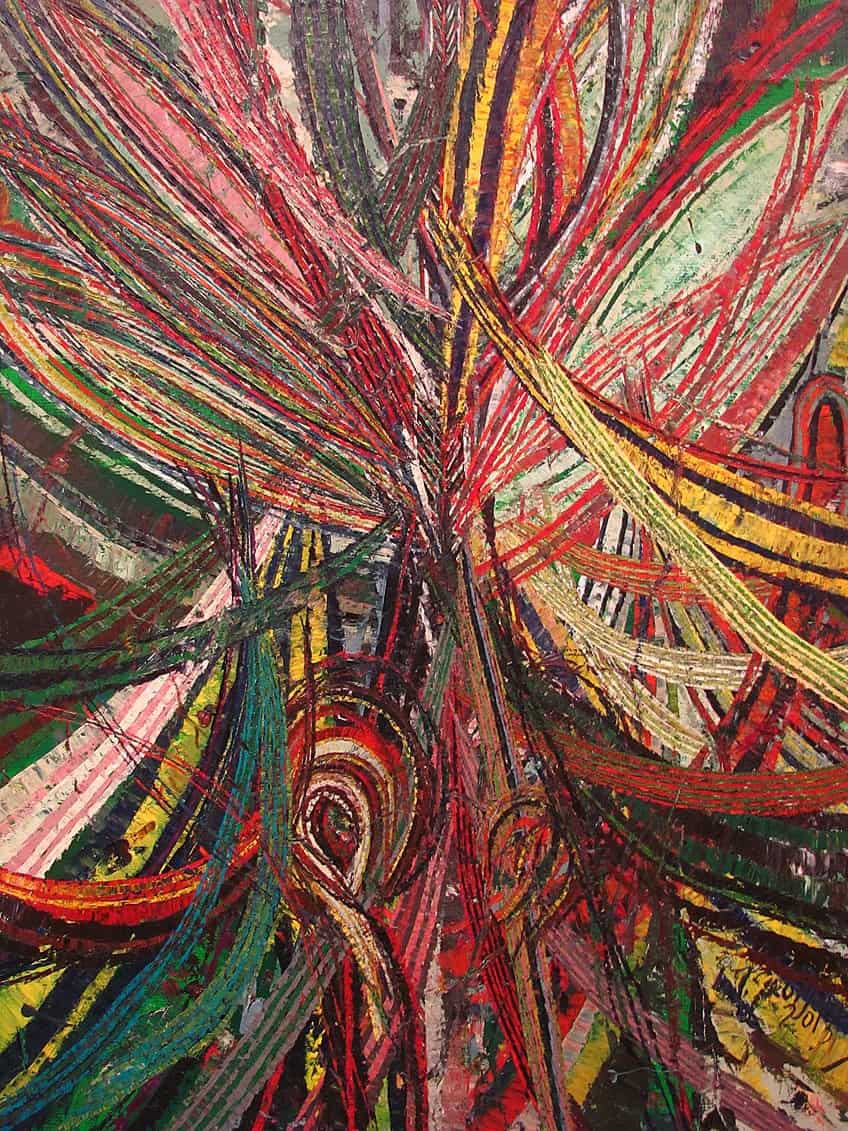
The support remains significant. Grotjahn paints on cardboard mounted on linen, scraping and sometimes carving into the surface to reveal buried color. Small rolls of excess impasto may interrupt the larger strokes, continuing the process first developed in the Free Capri paintings. The 2024 exhibition Out of Country presented the concluding works in the Backcountry series.
White-ground paintings appeared alongside a single black-ground example, demonstrating how changes in the underlying field could shift the apparent atmosphere of related gestures.
How to Recognize a Mark Grotjahn Work
- Lines radiating toward several vanishing points rather than one stable center
- Paired, wing-like arrangements divided by a vertical axis
- Symmetry that becomes irregular when examined closely
- Eye or mask forms emerging from abstract patterns
- Thick oil paint carved, scraped, or cut to expose underlying material
- Cardboard used as a visible and physically vulnerable support
- Residual marks that record other drawings or studio procedures
- Serial titles containing colors, numbers, initials, or workgroup names
- Signatures treated as active compositional elements
A Common Misconception: The Geometry Is Not Mechanically Perfect
The Butterfly drawings are sometimes mistaken for products of strict mathematical planning or digital design. Their clean radial structures support that first impression, but close examination reveals a different process. Grotjahn often located convergence points by eye. Colored-pencil bands contain variations in density, edges drift, and stray lines remain visible. Even when a procedure regulates the order of colors or the direction of work, physical execution introduces difference.

The later gestural paintings do not abandon this systematic thinking. Repeated supports, related dimensions, numbered titles, recurring motions, and established studio techniques continue to regulate the work. Geometry and gesture are not opposing periods in his career; they are interdependent methods.
Major Museum Exhibitions and Collections
Hammer Projects: Mark Grotjahn, held in Los Angeles in 2005, presented seven drawings focused on radiating and converging perspective. The Whitney Museum’s 2006–07 exhibition expanded the architectural impact of these structures through a cycle of large perspective drawings. The Aspen Art Museum organized his first comprehensive museum survey in the United States in 2012.
It brought together works from the late 1990s through the early 2010s, including examples from the Perspective, Butterfly, and Face series as well as five mask sculptures.
The Nasher Sculpture Center followed with Mark Grotjahn Sculpture in 2014, while LACMA presented 50 Kitchens in 2018. His work has also appeared in collection exhibitions at institutions including the Museum of Modern Art. Public collections holding his work include MoMA, The Broad, the Hammer Museum, LACMA, the Museum of Contemporary Art in Los Angeles, the San Francisco Museum of Modern Art, Tate, and the Whitney Museum of American Art.
Why Grotjahn’s Repetition Matters
Mark Grotjahn’s work demonstrates how repetition can generate difference rather than eliminate it. The Butterfly format turns small changes in color and convergence into perceptual events. The Face paintings use a recurring frontal structure to hold increasingly dense gestures, while the Mask sculptures translate improvised cardboard forms into painted bronze.
Later series loosen these recognizable frameworks without discarding the habits behind them. Paint is deposited, removed, carved, rolled, and relocated; surfaces retain a record of decisions and revisions. Even the most spontaneous passage belongs to a larger sequence.

This continuing negotiation between structure and contingency gives Grotjahn’s practice its coherence. Perspective becomes pattern, pattern approaches a face, a cardboard face becomes bronze, and thick paint begins to evoke landscape. Each transformation starts with something already established and discovers how far it can be changed without losing its identity.
Frequently Asked Questions
What Is Mark Grotjahn Best Known For?
He is best known for the geometric Butterfly drawings and paintings, the heavily worked Face paintings, and painted bronze sculptures based on improvised cardboard masks.
Are the Butterfly Works Pictures of Insects?
No. The name refers to their paired, wing-like arrangement. Bands of color radiate from separate vanishing points on either side of a central division, creating a structure that resembles bilateral wings.
What Materials Does Grotjahn Use?
His principal materials include colored pencil on paper and oil paint applied to cardboard, canvas, or linen-mounted cardboard. His sculptures originated as cardboard boxes and tubes, with many later versions cast in bronze and painted.
Why Does He Paint on Cardboard?
Cardboard responds visibly to pressure, cutting, scraping, and heavy paint. Its creases and exposed layers become part of the image. It also connects the paintings materially to the cardboard constructions underlying the Mask sculptures.
What Is a Vanishing Point?
A vanishing point is the apparent location where parallel lines converge in a perspective drawing. Renaissance artists used it to create convincing depth. Grotjahn multiplies or dislocates these points, making the perspective system itself visible and unstable.
What Is Impasto?
Impasto is paint applied thickly enough for its raised surface and brushmarks to remain visible. Grotjahn builds substantial oil layers that can be scraped, carved, or removed and repositioned.
What Was Sign Exchange?
Sign Exchange was a project conducted from 1993 to 1998. Grotjahn copied signs belonging to small businesses and offered the painted replicas in exchange for the originals. His copies entered the stores, while the acquired signs became part of the artwork.
Did Grotjahn Stop Making Geometric Work After Beginning the Face Series?
No. His bodies of work overlap, and geometric thinking remains present in later paintings. The Face, Capri, and Backcountry works loosen earlier perspective structures but continue to employ repetition, axes, arcs, and procedural rules.
Cite this Article
artincontext, , “Mark Grotjahn – From Vanishing Points to Carved Fields of Paint.” Art in Context. September 30, 2026. URL: https://artincontext.org/mark-grotjahn/
, a. (2026, 30 September). Mark Grotjahn – From Vanishing Points to Carved Fields of Paint. Art in Context. https://artincontext.org/mark-grotjahn/
, artincontext. “Mark Grotjahn – From Vanishing Points to Carved Fields of Paint.” Art in Context, September 30, 2026. https://artincontext.org/mark-grotjahn/.


