


Facts About Paul Klee – The Artistic Alchemist

Paul Klee (1879-1940) left behind roughly 9,600 works, most of them small enough to hold in two hands. He played the violin before he painted, taught for a decade at the Bauhaus, and saw 102 of his pictures pulled out of German museums by the Nazis.
Paul Klee at a Glance
Key dates:
| 1879 | Born in Münchenbuchsee near Bern to a German music teacher and a Swiss singer |
| 1898-1901 | Trains as a draftsman and painter in Munich |
| 1911-1912 | Joins the circle around Der Blaue Reiter; meets Kandinsky, Franz Marc and August Macke |
| 1914 | Two weeks in Tunisia; color becomes his subject |
| 1916-1918 | Drafted; aircraft unit, then clerk in a paymaster’s office |
| 1921-1931 | Form master at the Bauhaus in Weimar and Dessau |
| 1933 | Dismissed in Düsseldorf, leaves Germany for Bern |
| 1937 | 17 works shown in the Nazi “Degenerate Art” exhibition |
| 1940 | Dies on 29 June at Muralto, near Locarno |
The Influence of Paul Klee
Klee’s ideas traveled through teaching and writing rather than through a school of followers. Kandinsky was not his pupil but his colleague and, from 1926, his neighbor in the Dessau masters’ houses; the two exchanged theory for years.
His work reached Paris through his 1925 solo exhibition and the first Surrealist group show that same year, where Joan Miró and the poets around André Breton claimed him as a kindred spirit.
Klee never joined the movement. After 1940 his small-format sign language was absorbed by American painters, with Adolph Gottlieb’s pictographs among the clearest cases. His Bauhaus courses on line, color and form, condensed into the Pedagogical Sketchbook of 1925, remain in use in art schools.
10 Interesting Facts About Paul Klee

Klee Had a Gift for More Than Just Painting
Both of Klee’s parents were musicians, and he took up the violin at seven. By eleven he was playing with the Bern Music Association, and he earned money as a violinist while his painting career was still unpaid.
He married the pianist Lily Stumpf, whose teaching supported the household for years, and he kept up his morning practice long after he had chosen the studio over the orchestra.
He Had Many Artistic Influences
Klee absorbed Van Gogh and Cézanne, then the Munich circle of Der Blaue Reiter, and later cubism. The decisive encounter was Robert Delaunay, whose Paris studio he visited in 1912 and whose essay on light he translated into German for the magazine Der Sturm the following year.

Klee Was Also a Teacher
Klee taught at the Bauhaus from 1921 to 1931 as a form master, the title the school used instead of professor. He ran the bookbinding and stained glass workshops, later the weaving workshop, and gave the course on pictorial form.
His Pedagogical Sketchbook of 1925 appeared as the second volume in the Bauhaus book series and turned his teaching on the moving line and the growing form into a manual others could use.
He left for the Düsseldorf Academy in 1931.
He Painted Camouflage Onto Planes
Assigned in August 1916 to an aircraft reserve unit at Oberschleissheim, Klee did skilled manual work on damaged machines, including repainting camouflage on wings and fuselages, and escorted aircraft transports by rail. He also stripped canvas from crashed planes and used it.
Some of His Works Were Included in the “Degenerate Art” Exhibition
Seventeen works by Klee hung in the Nazi “Degenerate Art” exhibition that opened in Munich in 1937, among some 650 pieces displayed with mocking commentary. In the same campaign, 102 of his works were removed from German public collections.
He was by then living in Switzerland, and the confiscations cost him the German market that had carried his prices through the 1920s.
Klee’s Art Was Banned in Germany
The exclusion came fast. On 1 February 1933 the Nazi paper Die Rote Erde falsely denounced him as “a typical Galician Jew”; in March the Gestapo searched the Klees’ house in Dessau, and in April he was suspended from his Düsseldorf professorship. He was formally dismissed and emigrated to Bern in December 1933, after which his German market shrank steadily, collapsing with the confiscations of 1937.

Cats Were His Favorite Animal
Klee kept cats all his life, among them Bimbo, Fritzi, Mys and Nuggi, and let them move freely through the studio. They turn up in the work as flat, frontal faces that fill the whole picture surface.
Cat and Bird (1928, oil and ink on gessoed canvas mounted on wood, 38.1 × 53.2 cm, Museum of Modern Art, New York) places the bird on the cat’s forehead rather than in front of it: the prey sits inside the thought.
A Trip to Tunisia Transformed His Art
Klee traveled to Tunisia in April 1914 with August Macke and Louis Moilliet. The trip lasted two weeks. In Kairouan he wrote in his diary that color had taken hold of him and would not let go: “Color and I are one. I am a painter.”
What that meant in practice is visible in Hammamet with Its Mosque (1914, watercolor and graphite on paper mounted on cardboard, 23.8 × 22.2 cm, Metropolitan Museum of Art, New York). The upper third still reports a place: a mosque, two towers, a dark band of gardens. Below it the town breaks into rectangles of translucent watercolor that describe nothing. Cover the top strip and the sheet reads as pure abstraction; cover the bottom and it is a travel sketch. Klee spent the next twenty years working in the gap between the two.

He Served in World War I but Never Reached the Front
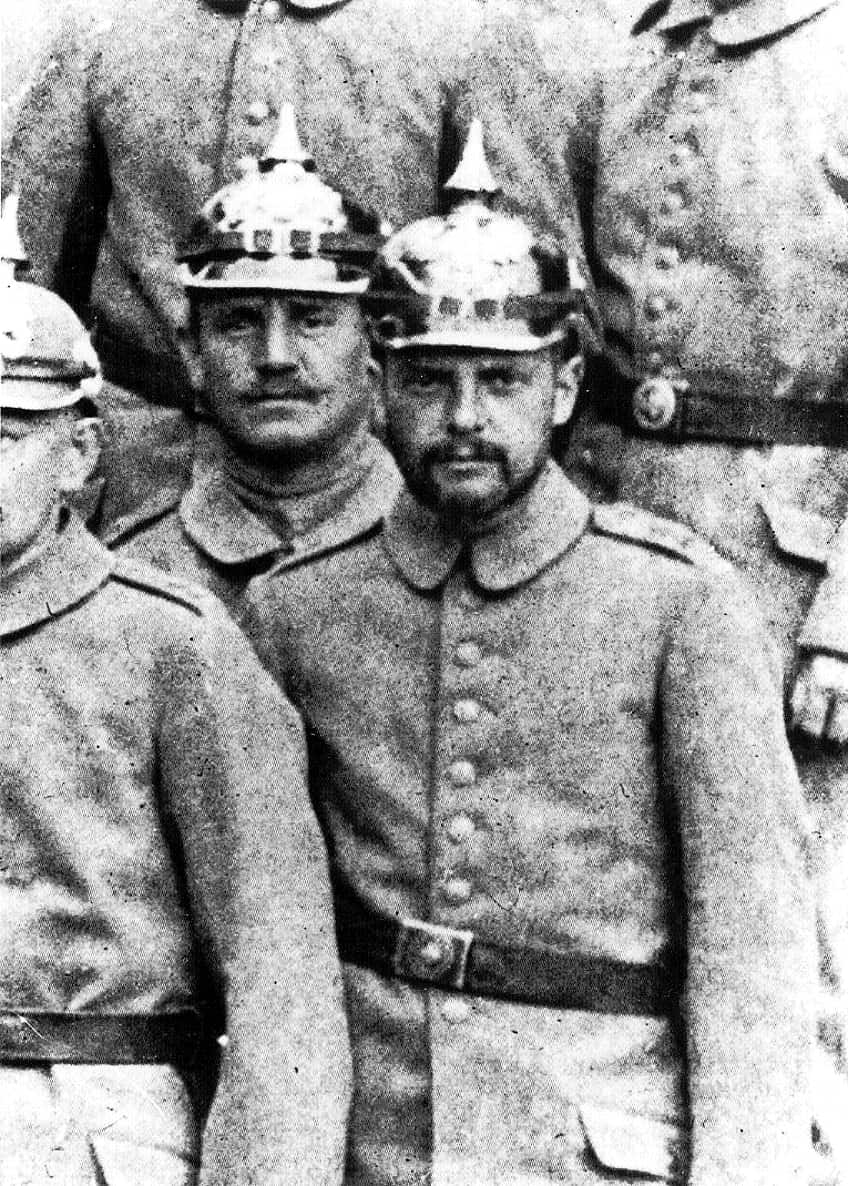
Klee held German citizenship through his father and was called up in March 1916, days after Franz Marc was killed at Verdun; Macke had died in Champagne in 1914. Klee himself was kept behind the lines, and from January 1917 he worked as a clerk in the paymaster’s office at Gersthofen near Augsburg.
He painted there in a rented room away from the barracks, and his reputation and prices grew while he was in uniform.
Paul Éluard Wrote a Poem About Him
The French poet Paul Éluard wrote the poem “Paul Klee” for the artist’s first solo exhibition in Paris in 1925 and published it a year later in his collection Capitale de la douleur. The two never worked together on a project. The poem is a reading of the pictures by a writer, and it marks the moment the Paris avant-garde adopted Klee.

Illness, Death and Where the Work Is Now
In 1935 Klee developed the first symptoms of scleroderma, a hardening of the skin and connective tissue that stiffened his hands and made painting physically difficult. His output collapsed, then surged: in 1939 alone he produced 1,253 works, most of them drawings, many with the thick black strokes of the late style. He died on 29 June 1940 at Muralto near Locarno.
He never became Swiss. Bern was scheduled to confirm his naturalization on 5 July 1940, six days after his death, so he remained a German citizen to the end.
The nine volumes of his catalogue raisonné, published between 1998 and 2004, document roughly 9,600 works. Around 4,000 of them, close to 40 percent of the whole, are held by the Zentrum Paul Klee in Bern, the Renzo Piano building that opened in 2005.
Frequently Asked Questions
What Were Some of Paul Klee’s Artistic Influences?
Klee took color theory from Robert Delaunay, a taste for the symbolic and the crude from children’s drawings and folk art traditions, and the license to abstract from the Munich expressionists around Der Blaue Reiter. Cubism gave him the grid he filled with color squares after Tunisia.
What Was Paul Klee’s Role at the Bauhaus?
Klee was a form master, responsible for the artistic side of a workshop while a craft master handled technique. He led bookbinding, then stained glass, then weaving, and lectured on pictorial form. Close to 4,000 pages of his teaching notes survive.
How Did Paul Klee’s Art Contribute to the Degenerate Art Exhibition?
Seventeen Klee works were hung in the 1937 Munich exhibition as examples of what the regime wanted discredited. The confiscated pieces were never returned to the museums that owned them: the state sold what it could abroad for foreign currency, and ownership disputes over individual works have run into the present century.
Was Paul Klee a Surrealist?
No. Klee was shown in the first Surrealist group exhibition in Paris in 1925 and admired by Éluard, Miró and Max Ernst, but he never joined the movement or signed its manifestos. He worked from a theory of form he built himself and taught at the Bauhaus, which the Surrealists had no part in.

Isabella studied at the University of Cape Town in South Africa and graduated with a Bachelor of Arts majoring in English Literature & Language and Psychology. Throughout her undergraduate years, she took Art History as an additional subject and absolutely loved it. Building on from her art history knowledge that began in high school, art has always been a particular area of fascination for her. From learning about artworks previously unknown to her, or sharpening her existing understanding of specific works, the ability to continue learning within this interesting sphere excites her greatly.
Her focal points of interest in art history encompass profiling specific artists and art movements, as it is these areas where she is able to really dig deep into the rich narrative of the art world. Additionally, she particularly enjoys exploring the different artistic styles of the 20th century, as well as the important impact that female artists have had on the development of art history.
Learn more about Isabella Meyer and the Art in Context Team.
Cite this Article
Isabella, Meyer, “Facts About Paul Klee – The Artistic Alchemist.” Art in Context. March 25, 2024. URL: https://artincontext.org/facts-about-paul-klee/
Meyer, I. (2024, 25 March). Facts About Paul Klee – The Artistic Alchemist. Art in Context. https://artincontext.org/facts-about-paul-klee/
Meyer, Isabella. “Facts About Paul Klee – The Artistic Alchemist.” Art in Context, March 25, 2024. https://artincontext.org/facts-about-paul-klee/.


