

Barnes Opens Noguchi to Asawa, Recasting Modernism

The Barnes Foundation has opened Noguchi to Asawa: Designing Postwar America, bringing six Japanese American artists into one account of postwar modernism. Its argument is consequential but needs precision: four of the artists were forcibly incarcerated, Isamu Noguchi entered a camp voluntarily and then lost his freedom to leave, and Leo Amino served the US Navy outside the camps.
Noguchi to Asawa Opens in Philadelphia
Noguchi to Asawa: Designing Postwar America runs in the Barnes Foundation’s Roberts Gallery from September 20, 2026, through January 10, 2027. Organized by Barnes curator Cindy Kang, it joins sculpture, furniture, fiber art, and graphic design rather than treating those fields as separate histories. The museum calls it the first exhibition to unite this particular group.
The Barnes exhibition record names Isamu Noguchi, George Nakashima, Leo Amino, S. Neil Fujita, Kay Sekimachi, and Ruth Asawa. Its central claim is that wartime incarceration and its aftermath did not sit outside American modernism: they helped determine who received training, which materials became available, where careers restarted, and how modern design reached American homes.
That claim rests on a federal history larger than the gallery. After Executive Order 9066, about 122,000 people were forcibly moved to assembly centers and inland camps, nearly 70,000 of them US citizens, according to the National Archives. The six artists did not experience that system in the same way, and their differences are essential to understanding the show.
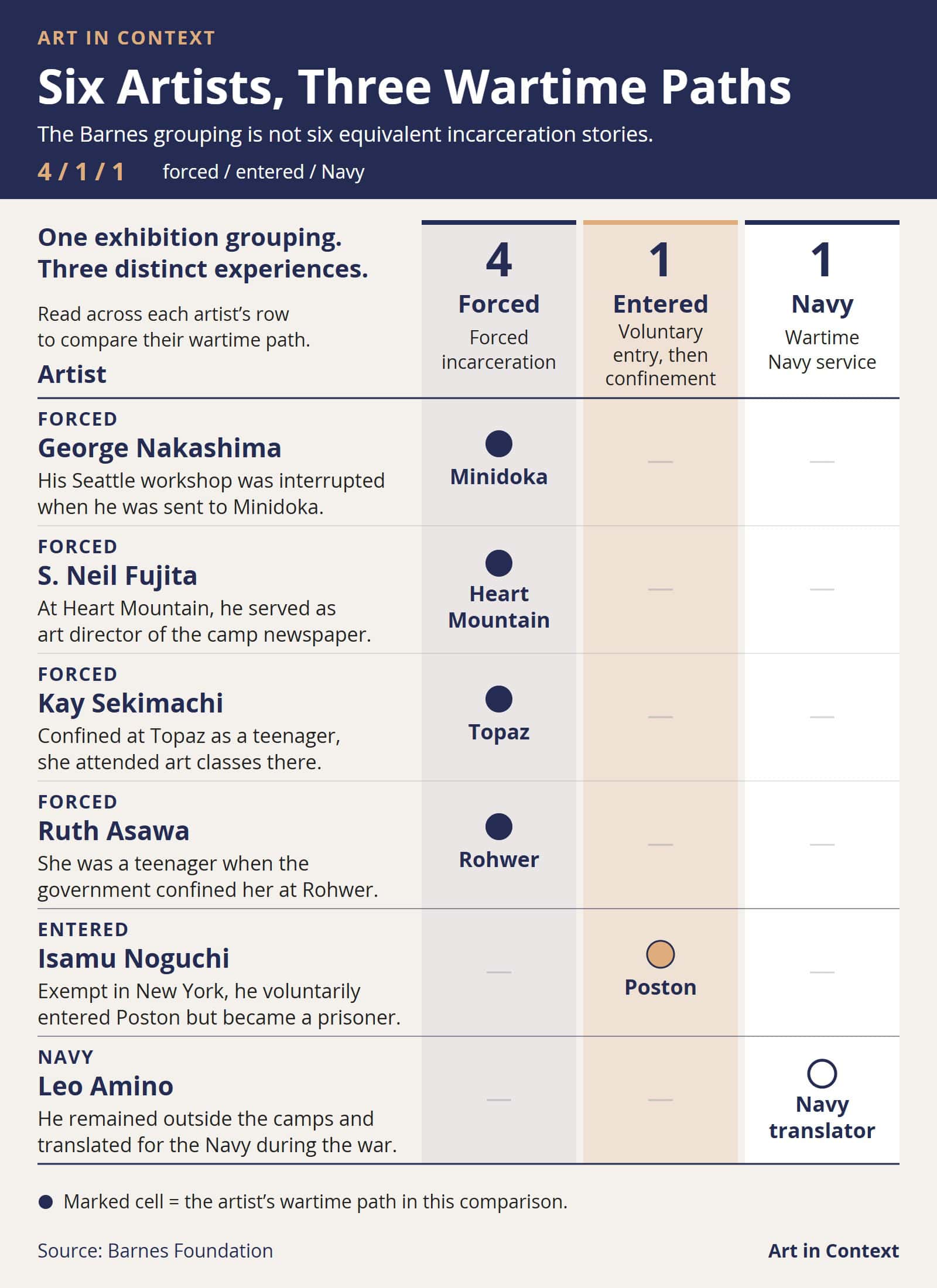
Six Artists, Three Wartime Positions
The grouping is historically productive precisely because it is not six equivalent incarceration stories. The artists’ wartime histories overlap: four were forcibly incarcerated, and Fujita later volunteered for the 442nd, while Noguchi entered Poston voluntarily and Amino worked for the Navy outside the camps.
| Artist | Wartime position | Exhibition evidence |
|---|---|---|
| Isamu Noguchi | Entered Poston voluntarily; was then confined | My Arizona (1943) |
| George Nakashima | Forced to Minidoka with his family | Milk House Coffee Table (c. 1943–44) |
| Leo Amino | New York resident; Navy translator | Refractional #47 (1969) |
| S. Neil Fujita | Forced to Heart Mountain | Time Out cover (1959) |
| Kay Sekimachi | Forced to Topaz as a teenager | Kunoyuki (c. 1968) |
| Ruth Asawa | Forced to Santa Anita and Rohwer | Seven-lobed wire form (c. 1954) |
Noguchi was exempt from West Coast removal because he lived in New York. He went to Poston hoping to develop art and recreation programs, but the Barnes records that he became a prisoner once inside. Amino, also based in New York, was not incarcerated; he translated for the Navy. Nakashima, Fujita, Sekimachi, and Asawa were forcibly confined. Calling all six “incarcerated artists” would erase a distinction that the exhibition’s own records preserve.
That asymmetry is the exhibition’s central curatorial argument. The exhibition tracks wartime upheaval through direct confinement, interrupted education, military service, new industrial materials, and the difficult geography of resettlement. The common subject is not a single camp experience but the way incarceration and its wartime context reached American cultural production.

Barracks at the Minidoka incarceration camp, August 1943. War Relocation Authority photograph, U.S. National Archives.
The Evidence Runs From Direct Record to Interpretation
Three objects make the wartime connection unusually concrete. Noguchi created My Arizona in 1943 after leaving Poston; its white relief resembles an aerial view of the desert. Nakashima made the Milk House Coffee Table soon after leaving Minidoka and settling in New Hope, Pennsylvania, using teak that his friend Morris Graves had kept for him in Washington State and shipped east. The wood’s journey is part of the object’s history of displacement.
Fujita’s evidence begins inside Heart Mountain. He served as art director of the camp newspaper, Heart Mountain Sentinel, and drew the mountain for its masthead. WRTI’s visit to the installed exhibition records a replica of the January 1, 1943, issue, later works on paper, and a wall of his Columbia Records covers. The sequence connects camp-era graphic work to the commercial images he later made for albums including Time Out and Mingus Ah Um.
Asawa and Sekimachi also received early art instruction while confined. Asawa studied with professional artists at the Santa Anita assembly center before her family was moved to Rohwer. Sekimachi learned origami, painting, and drawing in camp before taking up weaving after the war. Their later hanging forms are visually comparable, but they arrived there through different techniques: Asawa looped wire, while Sekimachi used the loom and eventually transparent nylon monofilament.
The formal readings require more care. The Barnes says scholars have connected Asawa’s wire and repetitive looping to barbed wire and agricultural labor; that is a scholarly interpretation, not a documented statement that incarceration directly caused every looped sculpture. The museum relates Sekimachi’s transparent Kunoyuki to visibility and invisibility in the Asian American movement of the late 1960s. Amino’s case is different again: his postwar turn to plastics links his sculpture to materials developed through wartime industry, not to personal confinement.
The exhibition is strongest when those levels of evidence remain visible. A dated newspaper designed in camp, a table made from displaced wood, and a later interpretation of transparency do not prove the same kind of relationship. Together, however, they show how biography, material history, and subsequent meaning can converge without becoming interchangeable.

Bill Hosokawa works on the Heart Mountain Sentinel at the Cody Enterprise press room, January 1943. Photograph by Tom Parker, U.S. National Archives.
Modernism Entered the Home by Several Routes
The shared result was not one look but broad circulation. Noguchi’s Akari light sculptures and IN-50 table entered domestic interiors; Nakashima’s furniture moved between studio craft and companies such as Knoll; Fujita’s abstractions reached record stores and bookshelves. Sekimachi and Asawa turned industrial thread and wire into suspended volume, while Amino made translucent resin sculpture that asked viewers to look through color.
WRTI reports that the final gallery evokes a midcentury living room, combining a Noguchi coffee table, a Nakashima chair, a Sekimachi placemat, and Fujita’s covers. That installation makes the historical thesis legible: these artists were not peripheral suppliers of ethnic motifs but makers of objects through which postwar America pictured modern life.
Their relationships to Japanese artistic traditions were neither uniform nor exclusive. Nakashima combined Japanese joinery with American vernacular and Shaker forms; Sekimachi later returned to Japanese paper; Fujita worked inside US mass media. The label “Japanese American” identifies a political and social history here, not a single national style.
Seen together, the six careers reveal two stages that conventional accounts often separate: survival and resettlement shaped the conditions of work, while manufacturers, publishers, galleries, and households spread the results. The Barnes makes both stages part of modernism’s history.

A young resident at Rohwer begins a wood carving in 1943; this contextual photograph does not show one of the six featured artists. Photograph by Tom Parker for the War Relocation Authority, via Wikimedia Commons. Creative Commons Public Domain Mark 1.0. Cropped.
Four Findings From the Barnes Exhibition
- Noguchi to Asawa opened September 20 and remains at the Barnes through January 10, 2027.
- The six artists represent three distinct wartime positions, not six identical histories of incarceration.
- The most direct object histories belong to Noguchi, Nakashima, and Fujita; the readings of Asawa, Sekimachi, and Amino more openly combine biography with material and formal interpretation.
- The Barnes and Yale exhibition listings name Philadelphia only; no later venue is currently listed.

Isabella studied at the University of Cape Town in South Africa and graduated with a Bachelor of Arts majoring in English Literature & Language and Psychology. Throughout her undergraduate years, she took Art History as an additional subject and absolutely loved it. Building on from her art history knowledge that began in high school, art has always been a particular area of fascination for her. From learning about artworks previously unknown to her, or sharpening her existing understanding of specific works, the ability to continue learning within this interesting sphere excites her greatly.
Her focal points of interest in art history encompass profiling specific artists and art movements, as it is these areas where she is able to really dig deep into the rich narrative of the art world. Additionally, she particularly enjoys exploring the different artistic styles of the 20th century, as well as the important impact that female artists have had on the development of art history.
Learn more about Isabella Meyer and the Art in Context Team.
Choose Art in Context as a preferred source to see more of our reporting in Google Top Stories and other Google Search experiences.
Cite this Article
Isabella, Meyer, “Barnes Opens Noguchi to Asawa, Recasting Modernism.” Art in Context. September 20, 2026. URL: https://artincontext.org/noguchi-to-asawa-barnes-foundation-opening/
Meyer, I. (2026, 20 September). Barnes Opens Noguchi to Asawa, Recasting Modernism. Art in Context. https://artincontext.org/noguchi-to-asawa-barnes-foundation-opening/
Meyer, Isabella. “Barnes Opens Noguchi to Asawa, Recasting Modernism.” Art in Context, September 20, 2026. https://artincontext.org/noguchi-to-asawa-barnes-foundation-opening/.


