

Trump Calls for Washington Statue to Replace Smithsonian’s Infinity

President Donald Trump has called on the Smithsonian to replace José de Rivera’s Infinity with a 30-foot statue of George Washington. The proposal targets a 1967 kinetic sculpture conceived for the National Museum of American History’s Mall entrance, but it is a request—not an announced removal decision.
Trump’s Three Smithsonian Requests Are Not One Project
The timing matters. Trump made the requests in Truth Social posts late on September 11, 2026; the Associated Press published its report on September 12. His follow-up post grouped three actions, but only one would displace Infinity.
| Request | Timing | Status on September 13 |
|---|---|---|
| 11-foot Washington statue in Flag Hall | Dedicate September 17 | Requested; object already exists |
| Washington exhibition | Now through February 22, 2032 | Requested; no announced exhibition |
| 30-foot Washington “Colossus” replacing Infinity | When ready | Concept requested; no announced removal |
The 11-foot statue is a particular object already shown at the Freedom 250 Grand Prix, and Trump gave the Smithsonian a September 17 dedication date. The Washington exhibition is a separate programming request extending to the 300th anniversary of Washington’s birth. The proposed 30-foot “Colossus” has no comparable deadline; Trump wrote that it should be installed when ready.
No artist, approved design, budget, procurement schedule, or removal date for the 30-foot work appears in Trump’s posts.
Infinity Was Made for the Museum Entrance
Infinity was installed three years after the museum opened, although architect Walker O. Cain had promoted de Rivera’s proposal before the building was completed and treated the sculpture as part of its architectural concept. It was a federal art commission developed with the museum’s architecture and mission in mind.
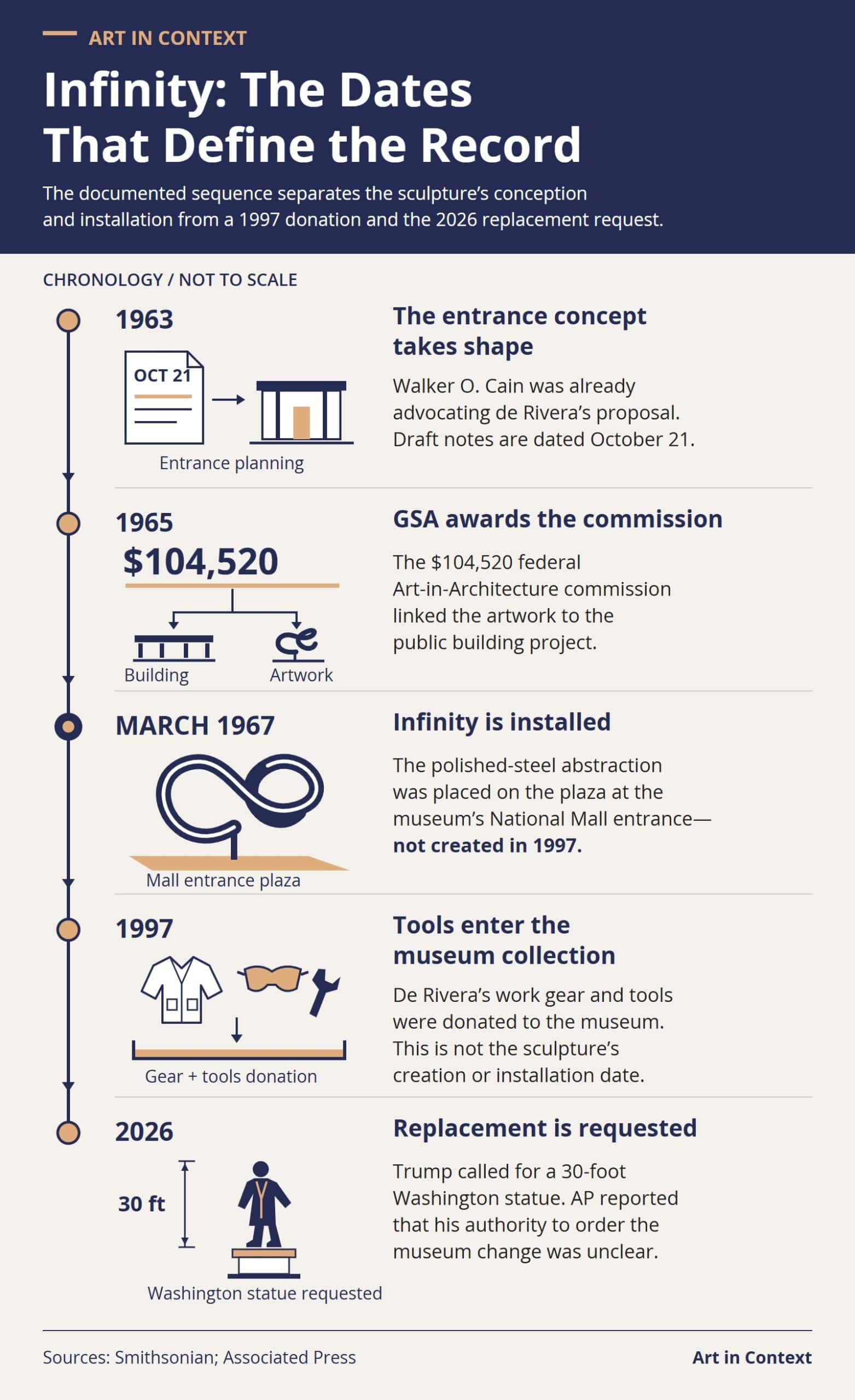
A 2008 study by Smithsonian curator David Shayt records that the General Services Administration awarded de Rivera a $104,520 commission in 1965. In March 1967, a crane lowered the polished-steel form onto a motorized shaft above its black-granite support at what was then the National Museum of History and Technology.
De Rivera and fellow direct-metal sculptor Roy Gussow spent two years fabricating the work from 800 pounds of threaded rod and stainless-steel plate in a Long Island City studio. The loop measures 16 feet across and turns roughly once every six minutes, slowly changing the reflections and apparent contours seen by a stationary viewer.
Museum architect Walker O. Cain promoted the proposal as a futuristic orrery, a mechanical model of the solar system. Shayt found no record that de Rivera shared that representational reading; the artist treated the work as an abstraction whose shifting relationships were its subject. The sculpture’s nonfigurative character was therefore deliberate, while its institutional rationale connected motion, technology, and modern architecture.
Trump’s description of Infinity as a “strange modernist sculpture” addresses an intentional feature rather than an accidental failure to depict a hero. The museum’s first director, Frank Taylor, regarded the sculpture as essential to the building’s architectural concept, according to the records cited by Shayt.

Infinity (1967) by José de Rivera outside the National Museum of American History. Photograph by Ron Cogswell, via Wikimedia Commons. Creative Commons Attribution 2.0 Generic; cropped.
The Date Error: 1967, Not 1997
One report has already blurred the sculpture’s chronology. A September 12 Daily Beast story says Infinity was created in 1997. The Smithsonian’s permanent historical record places its installation in March 1967, three decades earlier; AP also reports the 1967 date.
A work installed in 1967 has occupied this entrance for nearly six decades and belongs to the first wave of permanent modern sculpture on the National Mall. It is not a late-1990s addition to an older setting. Shayt describes it as a federally commissioned work of abstract art that opened the way for later permanent outdoor modern art on the Mall.
De Rivera, born in Louisiana in 1904, learned metalworking around the sugar mills where his father was a mechanical engineer. After study in Chicago and travel through European and North African museums and ancient sites, he settled in New York and developed a direct-metal practice focused on space, light, and motion. He died in 1985.
The 1937 photograph predates Infinity by three decades, but it makes the continuity in de Rivera’s practice visible: sculpture emerged from direct work with tools and metal. For Infinity, that hand-worked method was scaled up through Gussow’s welding expertise without disguising the result’s industrial precision.

José de Rivera at work in 1937. Photograph by Henry W. Hetzel for the Works Progress Administration, Archives of American Art, via Wikimedia Commons. Public domain.
A Presidential Request Is Not a Recorded Removal Decision
The Associated Press reported that it is unclear whether Trump can order the change. The Smithsonian operates outside the executive branch, and Congress vested responsibility for its administration in a 17-member Board of Regents. The board includes the vice president and chief justice, six members of Congress, and nine citizen regents.
That structure makes the posts evidence of presidential pressure, not evidence of institutional approval. The Smithsonian’s governance record says the Regents establish major policies and oversee their implementation, while the Secretary manages the institution.
The Daily Beast reported that the Smithsonian did not immediately respond to its request for comment. No Smithsonian announcement accepting the replacement or removing Infinity accompanied Trump’s request by September 13.
That status differs from the documented removal of the blue sculpture at the Kennedy Center, where a physical change had already occurred. At the National Museum of American History, the confirmed event is a call to change the site; Infinity remains the artwork attached to it.
What the Record Establishes About Infinity
The documentary record separates the confirmed facts from the proposal.
- Trump requested three distinct Smithsonian actions, and only the proposed 30-foot Washington statue would replace Infinity.
- Smithsonian sources trace the project to a 1963 commission and a $104,520 GSA commission in 1965, followed by the sculpture’s installation in March 1967.
- The Daily Beast’s 1997 creation date is wrong; the Smithsonian’s permanent history and AP both give 1967.
- The Board of Regents governs the Smithsonian, but no museum acceptance, approved design, removal date, or destination for Infinity had been announced by September 13.

Isabella studied at the University of Cape Town in South Africa and graduated with a Bachelor of Arts majoring in English Literature & Language and Psychology. Throughout her undergraduate years, she took Art History as an additional subject and absolutely loved it. Building on from her art history knowledge that began in high school, art has always been a particular area of fascination for her. From learning about artworks previously unknown to her, or sharpening her existing understanding of specific works, the ability to continue learning within this interesting sphere excites her greatly.
Her focal points of interest in art history encompass profiling specific artists and art movements, as it is these areas where she is able to really dig deep into the rich narrative of the art world. Additionally, she particularly enjoys exploring the different artistic styles of the 20th century, as well as the important impact that female artists have had on the development of art history.
Learn more about Isabella Meyer and the Art in Context Team.
Choose Art in Context as a preferred source to see more of our reporting in Google Top Stories and other Google Search experiences.
Cite this Article
Isabella, Meyer, “Trump Calls for Washington Statue to Replace Smithsonian’s Infinity.” Art in Context. September 13, 2026. URL: https://artincontext.org/trump-smithsonian-infinity-sculpture-removal-request/
Meyer, I. (2026, 13 September). Trump Calls for Washington Statue to Replace Smithsonian’s Infinity. Art in Context. https://artincontext.org/trump-smithsonian-infinity-sculpture-removal-request/
Meyer, Isabella. “Trump Calls for Washington Statue to Replace Smithsonian’s Infinity.” Art in Context, September 13, 2026. https://artincontext.org/trump-smithsonian-infinity-sculpture-removal-request/.


