

Claude Lévêque Ordered to Face Trial; Lawyers Appeal

A French investigating judge ordered artist Claude Lévêque to face a criminal trial in July 2026 over alleged sexual offenses against three people who were minors during the alleged conduct. The escalation became public this week, but Lévêque’s lawyers have appealed the committal order, so it is not a conviction and is not yet final.
The Claude Lévêque Trial Order Is a Referral, Not a Verdict
Le Parisien reported on September 10 that a judge had ordered Lévêque, 73, before the departmental criminal court of Seine-Saint-Denis. The alleged conduct spans 1989 to 2007; the three complainants were between 8 and 18 during that period. A more detailed account published by Le Monde on September 11 says the newspaper reviewed the committal order.
The reports do not use identical legal shorthand. Le Parisien, relaying information attributed to AFP and a source close to the case, describes alleged rapes and sexual assaults against minors. Le Monde gives labels from the order that include atteintes sexuelles avec violence, contrainte, menace ou surprise and attentats à la pudeur sur mineur de 15 ans par personne ayant autorité. Because the defense says its appeal concerns the legal classifications, those formulations are not a settled list of convictions.
A committal order closes the investigating stage by finding sufficient grounds to place accusations before a trial court. It does not decide guilt. Lévêque remains presumed innocent, and the three complainants’ accounts remain allegations unless and until adjudicated.
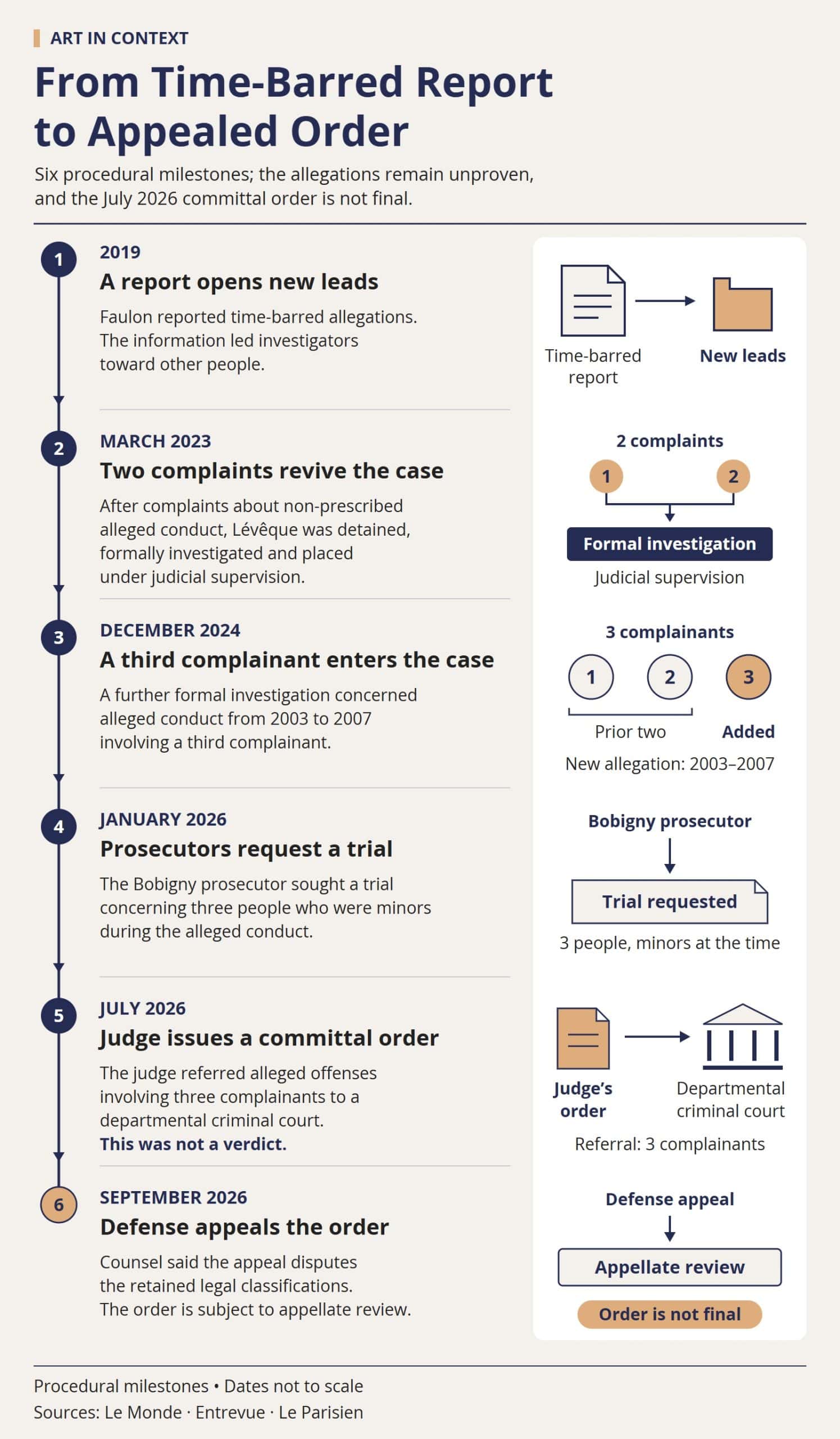
From the 2019 Complaint to the 2026 Appeal
| Date | Development |
|---|---|
| Feb.–Mar. 2019 | Artist and teacher Laurent Faulon alerted the Bobigny prosecutor. His allegations were time-barred, but he supplied other names and dates. |
| Jan. 2021 | Le Monde made Faulon’s accusations public. |
| Sept. 2021 | Lévêque was questioned without being held and disputed the characterization of the relationships. |
| Mar. 2023 | Two brothers filed complaints concerning non-prescribed alleged conduct. Lévêque was taken into custody, formally placed under investigation and put under judicial supervision. |
| Dec. 2024 | A further formal investigation concerned a third complainant and alleged conduct from 2003 to 2007. |
| Jan. 2026 | Prosecutors requested that the case proceed to trial. |
| July–Sept. 2026 | The judge issued the committal order in July; the defense appeal was disclosed in September. |
The public record contains a small date discrepancy at the beginning. Le Parisien dates Faulon’s letter to February 2019, while Le Monde describes the case as beginning in March. Le Monde reported in 2021 that Faulon sent the letter on February 20, 2019, despite describing the case in its 2026 account as beginning in March.
The chronology distinguishes Faulon’s time-barred allegations from the three complainants covered by the order, but the Bobigny prosecutor said alleged acts concerning five other people were time-barred. According to Le Monde, his 2019 account prompted investigators to pursue other leads. The July 2026 order concerns alleged acts against three other complainants, including two brothers whose 2023 complaints revived the case and a third person added at the formal-investigation stage in 2024.
Why Lévêque’s Art-World Status Is Part of the Case
Lévêque is not merely a famous defendant who happens to make art. An official Cnap record states that he represented France at the 2009 Venice Biennale with the installation Le Grand Soir and made a monumental intervention for the Louvre Pyramid in 2014. Cnap describes his practice as immersive environments of light, sound and altered space. The Centre Pompidou lists works including Valstar Barbie (2003), placing him firmly within the institutional history of French contemporary art.
That career record matters because the committal order, as reported by Le Monde, treats artistic prestige as part of the alleged mechanism of control. It says witnesses and complainants described emotional pressure combined with continued access to the art world and its privileges. That is a judicial account of evidence collected during the investigation, not a finding of guilt, but it makes galleries, travel and professional access material to the prosecution’s theory rather than incidental biography.
The distinction is especially important because childhood appears in institutional descriptions of Lévêque’s work. The Pinault Collection describes childhood memories as one source for Lévêque’s sensory installations. That does not make the art evidence of an offense. It does mean that museums face a concrete interpretive problem: how to supply verified legal context without turning imagery, titles or themes into proof they cannot provide.
Institutional responses were already uneven by 2023. Le Monde reported that Fontevraud Abbey and the city of Montrouge had removed works, while Montreuil had switched off and later relit Modern Dance. The Hauts-de-Seine department said an energy-saving plan, not the allegations, explained why lighting on an Issy-les-Moulineaux bridge was off. These are curatorial decisions and ownership decisions, not judicial rulings. The new order raises their stakes but does not settle them.

The Louvre’s Cour Napoléon and pyramid, where Claude Lévêque later made a monumental intervention. Photograph by Briqus Orven Rémi, via Wikimedia Commons, licensed under CC BY-SA 3.0.
What the Appeal Changes Now
Lévêque’s lawyers, Patrick Klugman and Lucas Veil, told Le Monde that they appealed because of a dispute over the legal classifications retained in the order. Their statement said Lévêque had participated in the investigation, wished to apologize to the civil parties and wanted the truth to emerge. It was not a guilty plea.
Article 186 of France’s Code of Criminal Procedure gives a person under formal investigation the right to appeal orders made under Articles 181 and 181-1 and sets a ten-day filing period. The July committal order therefore cannot yet be treated as definitive. The appeal asks the appellate investigation chamber to review the committal order; it is not a trial of guilt.
If the committal ultimately stands, the French Justice Ministry explains that a departmental criminal court hears qualifying crimes at first instance before five professional judges, without a citizen jury. No trial date or appellate hearing date has been reported. Until the appeal is decided, the judge’s order remains subject to appellate review and is not an irreversible procedural step.
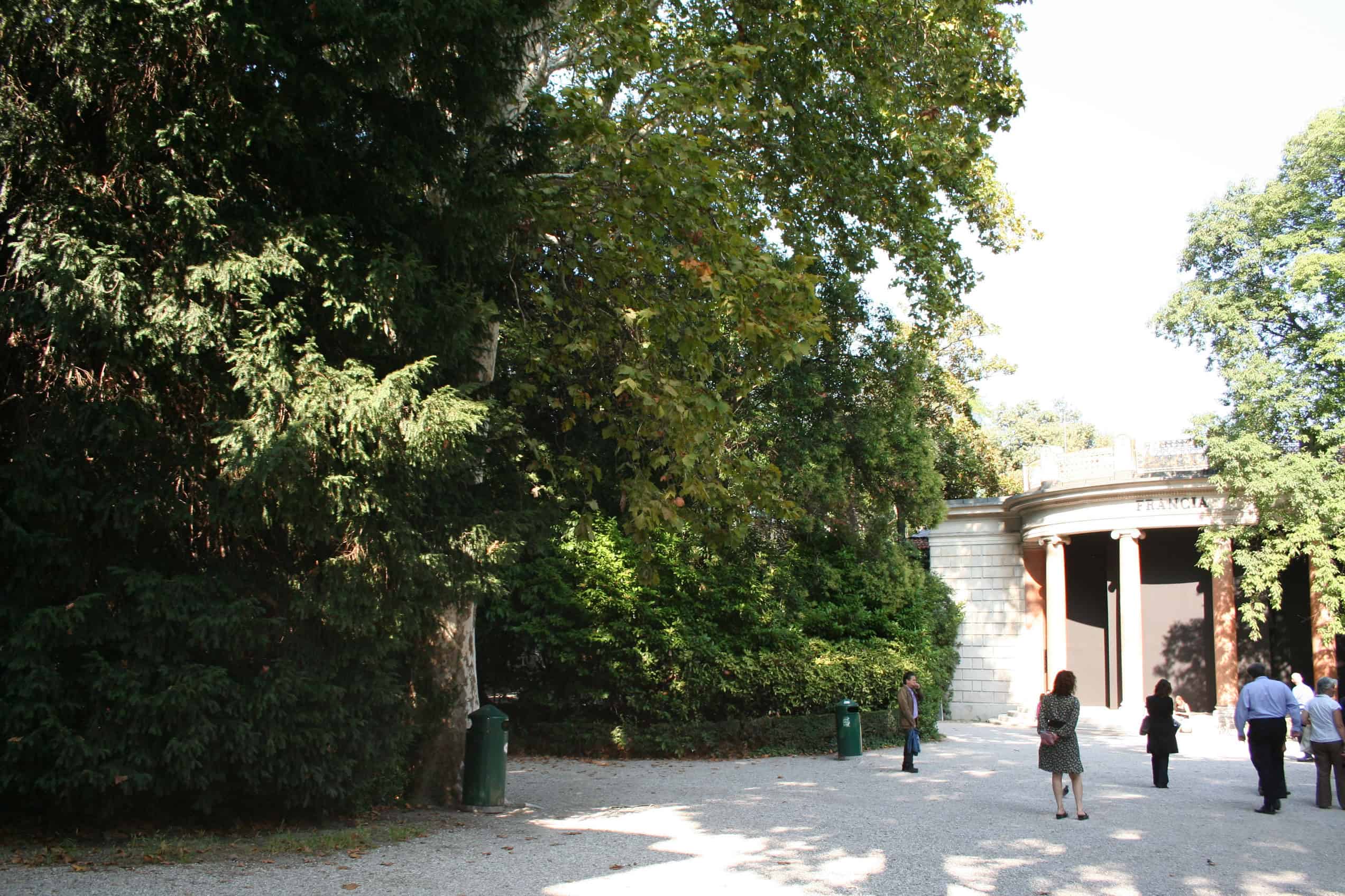
The French Pavilion in the Giardini during the 2009 Venice Biennale, when Claude Lévêque represented France. Photograph by Cyril S via Wikimedia Commons, Creative Commons Attribution-Share Alike 4.0 International; cropped.
Three Complainants, an Appealed Order and No Verdict
- The July order follows a January 2026 prosecution request and concerns alleged conduct against three complainants from 1989 to 2007; Le Monde and Le Parisien agree on that scope.
- Faulon’s 2019 allegations were time-barred, but Le Monde reports that his information led investigators toward later, non-prescribed complaints.
- The order reportedly places Lévêque’s artistic prestige and access to art-world privileges inside the alleged mechanism of control; Cnap’s official exhibition record establishes the institutional scale of that prestige.
- The defense has appealed the legal classifications. French law permits that appeal, no verdict has been reached, and neither an appellate date nor a trial date is public.
The status and interpretation of Lévêque’s works remain separate questions for each museum, collection and public owner.

Isabella studied at the University of Cape Town in South Africa and graduated with a Bachelor of Arts majoring in English Literature & Language and Psychology. Throughout her undergraduate years, she took Art History as an additional subject and absolutely loved it. Building on from her art history knowledge that began in high school, art has always been a particular area of fascination for her. From learning about artworks previously unknown to her, or sharpening her existing understanding of specific works, the ability to continue learning within this interesting sphere excites her greatly.
Her focal points of interest in art history encompass profiling specific artists and art movements, as it is these areas where she is able to really dig deep into the rich narrative of the art world. Additionally, she particularly enjoys exploring the different artistic styles of the 20th century, as well as the important impact that female artists have had on the development of art history.
Learn more about Isabella Meyer and the Art in Context Team.
Choose Art in Context as a preferred source to see more of our reporting in Google Top Stories and other Google Search experiences.
Cite this Article
Isabella, Meyer, “Claude Lévêque Ordered to Face Trial; Lawyers Appeal.” Art in Context. September 12, 2026. URL: https://artincontext.org/claude-leveque-trial-order-appeal/
Meyer, I. (2026, 12 September). Claude Lévêque Ordered to Face Trial; Lawyers Appeal. Art in Context. https://artincontext.org/claude-leveque-trial-order-appeal/
Meyer, Isabella. “Claude Lévêque Ordered to Face Trial; Lawyers Appeal.” Art in Context, September 12, 2026. https://artincontext.org/claude-leveque-trial-order-appeal/.


