

Painted Fifth-Dynasty Double Mastaba Documented at Saqqara

A joint Egyptian-Spanish mission has completed the excavation and scientific documentation of two adjoining chapels within a late Fifth-Dynasty double mastaba at Saqqara, identifying them with the official Yunmin and his father, Iti. The sharper finding is not simply that color survived: the two rooms preserve different visual programs, and the official record shows a discovery assembled across several field seasons rather than in a single moment.
What Survives in the Double Mastaba
Egypt’s Ministry of Tourism and Antiquities dates the medium-sized mastaba to the reign of Djedkare Isesi and places it in the Mariette Cemetery in northern Saqqara. Its official account says both funerary chapels open from the eastern wall. Yunmin’s principal chapel occupies the north; Iti’s is to the south.
The northern chapel has a formal image of Yunmin on a distinctive architectural facade, together with funerary texts and an offering formula. Inside, high-quality raised reliefs depict agricultural work and processions carrying offerings to the tomb. The ministry says a large number retain original color.
Iti’s southern chapel has a false door and colored wall decoration showing offerings, but the ministry also says much of that decoration has been lost. The distinction matters because “colors intact,” used in a Euronews headline, is broader than the primary evidence. Color survives substantially in Yunmin’s reliefs; the monument as a whole is not intact.
| Chapel | Documented visual program |
|---|---|
| Yunmin, north | Formal portrait, funerary and offering texts, raised farm scenes, offering processions, extensive surviving color |
| Iti, south | False door and colored offering scenes, with major losses |
The ministry says the mission finished the excavation and full scientific documentation of both chapels and implemented a conservation and restoration program for the architectural and decorated elements.
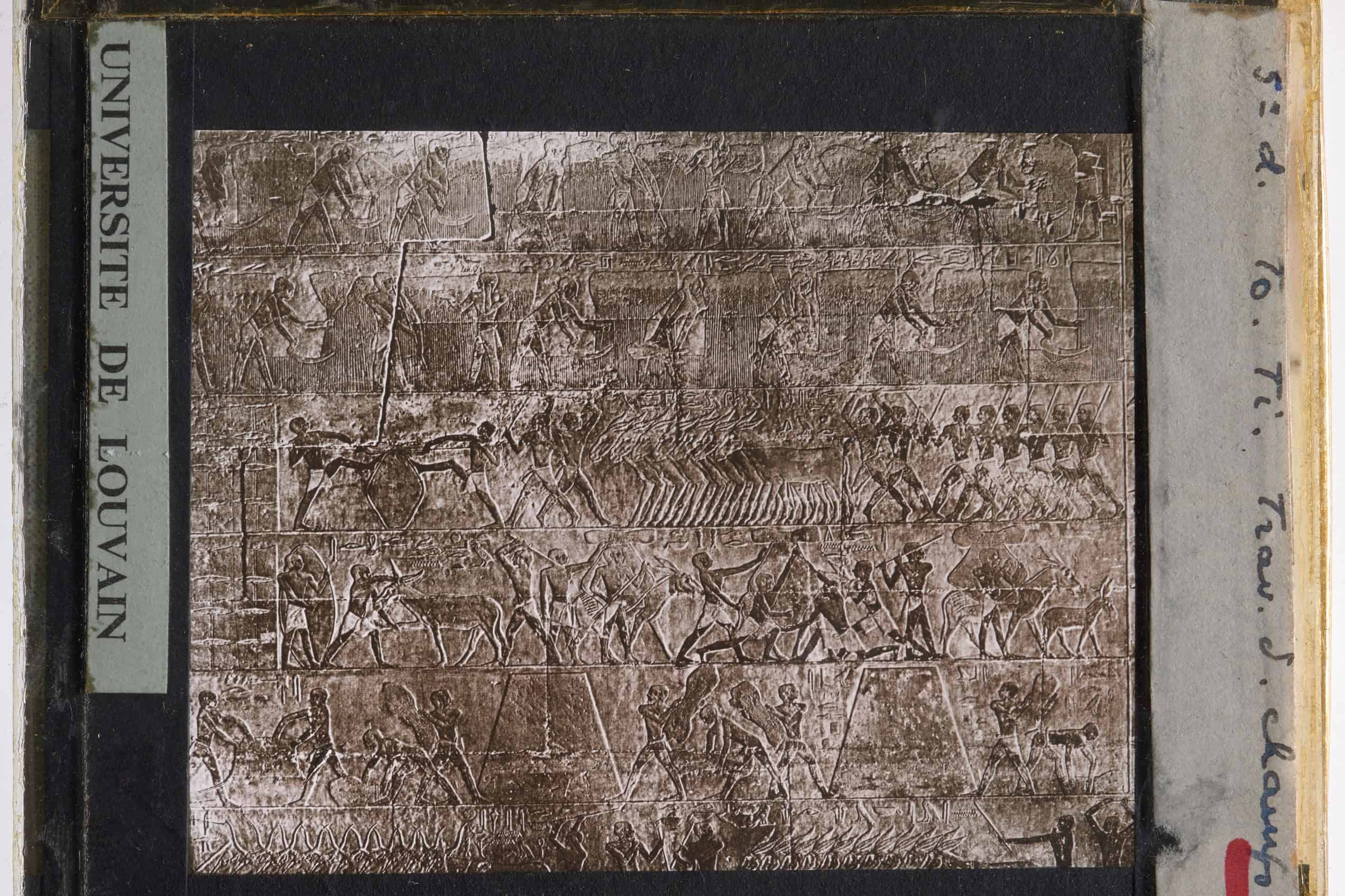
A Fifth-Dynasty agricultural relief in the Mastaba of Ti at Saqqara, shown as a period comparison rather than the newly documented Yunmin and Iti tomb. Photographer unknown; KU Leuven, EuroPhot collection, via Wikimedia Commons. Public domain; cropped.
The “Discovery” Extends From the 1860s to 2026
The word “discovery” compresses a long sequence. Mariette’s work established the broader cemetery, but Cervelló told EFE that mapping led the team to this previously unrecorded mastaba and indications of two others nearby.
- 1860s: Mariette excavated the mastaba field now called the Mariette Cemetery; the current mission describes its project as re-excavation and study of that sector.
- 2023: The UAB project moved into its northern Saqqara concession and began work at the site.
- 2024: The mission conducted on-site spatial, topographic, geological, archaeological, and geophysical surveys in June 2023; excavation began in 2024. A season record says three weeks of fieldwork exposed parts of three previously unrecorded mastabas around a north-south street, without yet reaching their chapels or learning their owners’ names.
- April–June 2026: The latest field campaign excavated and documented the Yunmin and Iti chapels.
- September 7–8, 2026: UAB presented the results at the Ibero-American Congress of Egyptology on September 7; news reports followed.
The UAB’s dated account is also more precise than reports describing a summer excavation: the campaign ran through April, May, and June. Those are event dates; September 7 is the university report’s publication date.
Even the age in headlines is an estimate, not a measurement announced by the excavation. Euronews called the tomb 4,400 years old, while ANSA called it 4,500 years old. The ministry supplies the firmer archaeological formulation: late Fifth Dynasty, specifically the reign of Djedkare Isesi. The two round numbers are headline arithmetic, not competing excavation dates.
Why the Reliefs Are More Than Pictures of Daily Life
The agricultural scenes belong to a well-established language of ancient Egyptian art, in which image, writing, architecture, and ritual worked together. A Metropolitan Museum of Art overview explains that agricultural and other daily-life scenes became common in Fifth- and Sixth-Dynasty elite tombs and were intended to provide for the deceased in the afterlife. Yunmin’s offering processions therefore do not function as neutral records of farming alone; they picture the continued delivery of resources to his funerary cult.
The contrast between the chapels is equally useful. Yunmin’s room preserves a broad narrative program in raised relief, while Iti’s surviving ensemble centers on the false door and offerings. A false door was not meant to open physically. In a comparable Fifth-Dynasty chapel from Saqqara, the Met describes it as a stylized doorway and the ritual point where visitors deposited offerings, understood as a place of contact between the living and the dead.
The new mastaba thus joined two related mechanisms: images made agricultural production and delivery perpetually available, while the false door focused the act of offering. The surviving asymmetry between the chapels is established; its cause is not.
Euronews reports that archaeologists read the shared tomb as evidence of Yunmin’s social ascent: a provincial official’s son rose into the central administration and chose a common funerary destiny with his father. The ministry establishes that the two men were father and son and records their offices, but its release does not give a construction sequence or state who commissioned the double arrangement.

The Fifth-Dynasty false door and architrave of Ptahshepses from Saqqara, photographed by Szilas in the British Museum and hosted by Wikimedia Commons under the Creative Commons Attribution-Share Alike 4.0 International license.
The Inscriptions Connect Office and Image
The names and titles give the decoration unusually specific administrative context. The ministry identifies Yunmin as a judge, court director, and chief scribe responsible for considering petitions and complaints. It identifies Iti as a scribe whose work concerned the management of agricultural lands and offerings.
That makes the images more pointed. Agriculture and offerings were not only generic signs of abundance in the northern chapel; they also evoke the material systems named in Iti’s duties. The tomb combines an ideal, renewable estate on its walls with inscriptions describing how land, records, complaints, and offerings were administered in life. The pairing itself is visible in the official record.
UAB describes the broader concession as a cemetery of Memphite high priests, yet the accessible ministry release introduces Yunmin and Iti through judicial, court, and scribal posts. It does not label either man a high priest.
What the Saqqara Evidence Now Establishes
The government record dates the mastaba to Djedkare Isesi’s reign and identifies two east-opening chapels: Yunmin’s to the north and Iti’s to the south.

Isabella studied at the University of Cape Town in South Africa and graduated with a Bachelor of Arts majoring in English Literature & Language and Psychology. Throughout her undergraduate years, she took Art History as an additional subject and absolutely loved it. Building on from her art history knowledge that began in high school, art has always been a particular area of fascination for her. From learning about artworks previously unknown to her, or sharpening her existing understanding of specific works, the ability to continue learning within this interesting sphere excites her greatly.
Her focal points of interest in art history encompass profiling specific artists and art movements, as it is these areas where she is able to really dig deep into the rich narrative of the art world. Additionally, she particularly enjoys exploring the different artistic styles of the 20th century, as well as the important impact that female artists have had on the development of art history.
Learn more about Isabella Meyer and the Art in Context Team.
Choose Art in Context as a preferred source to see more of our reporting in Google Top Stories and other Google Search experiences.
Cite this Article
Isabella, Meyer, “Painted Fifth-Dynasty Double Mastaba Documented at Saqqara.” Art in Context. September 9, 2026. URL: https://artincontext.org/saqqara-double-mastaba-yunmin-iti-painted-reliefs/
Meyer, I. (2026, 9 September). Painted Fifth-Dynasty Double Mastaba Documented at Saqqara. Art in Context. https://artincontext.org/saqqara-double-mastaba-yunmin-iti-painted-reliefs/
Meyer, Isabella. “Painted Fifth-Dynasty Double Mastaba Documented at Saqqara.” Art in Context, September 9, 2026. https://artincontext.org/saqqara-double-mastaba-yunmin-iti-painted-reliefs/.


