

Karahantepe’s Human-on-Leopard Sculpture Reverses a Neolithic Motif

Türkiye’s Culture and Tourism Ministry announced on August 25 that the 2026 excavations at Karahantepe uncovered an approximately 11,000-year-old sculpture of a human seated on a leopard. The 70-centimeter work reverses a human-and-predator arrangement already known at the site, but its original meaning remains unestablished because no detailed excavation report accompanied the announcement.
What Karahantepe’s 2026 Excavation Actually Found
The Ministry’s dated announcement is clear about the report date, not the day of discovery. It says only that the object emerged during the 2026 season. The official notice places the sculpture on a bench running along the wall of a structure about three meters in diameter, with a floor paved in flat stones.
Culture and Tourism Minister Mehmet Nuri Ersoy said the sculpture was found where it had been left approximately 11,000 years ago. That statement establishes the Ministry’s claim that the placement is ancient; the announcement does not provide a stratigraphic diagram, sealed deposits, or another published analysis showing how that conclusion was reached.
Anadolu Agency calls the object a stone sculpture but attributes its height and architectural setting to Ersoy rather than independently verifying them. The Ministry calls it a “composite sculpture,” but immediately describes the combination of a human and animal in one composition. “Composite” therefore should not be read as evidence that several materials were used, and the official notice does not identify a specific stone type.
The approximate age places the work within the visual world of Neolithic art, but it is not yet a precise archaeological date. The public notice supplies no dating method, calibrated range, stratigraphic phase, complete measurements, or conservation assessment.
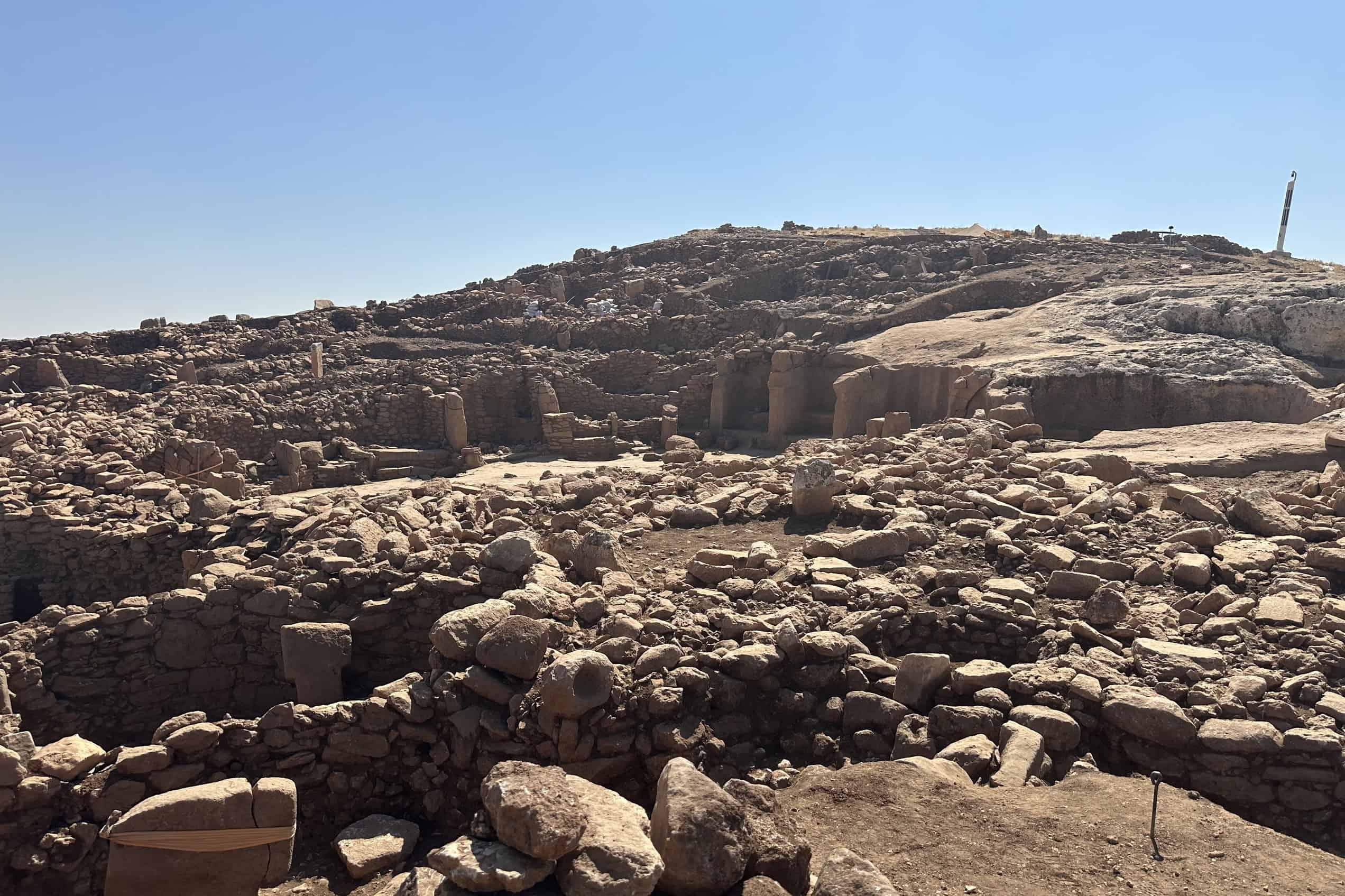
Karahantepe archaeological site in Şanlıurfa, Türkiye. Photograph by Vincent Vega, via Wikimedia Commons, licensed under Creative Commons Attribution-Share Alike 4.0 International; cropped.
The Human and Leopard Have Changed Places
The strongest comparison is not a generic history of feline symbolism. It is another sculpture excavated at Karahantepe and now displayed in the Şanlıurfa Archaeology Museum. A municipal collection catalogue identifies that earlier object as a “Human Statue Carrying a Leopard,” assigns it to the broad Pre-Pottery Neolithic range of 9400–8000 BCE, and records limestone, a height of 164 centimeters, and a width of 102 centimeters.
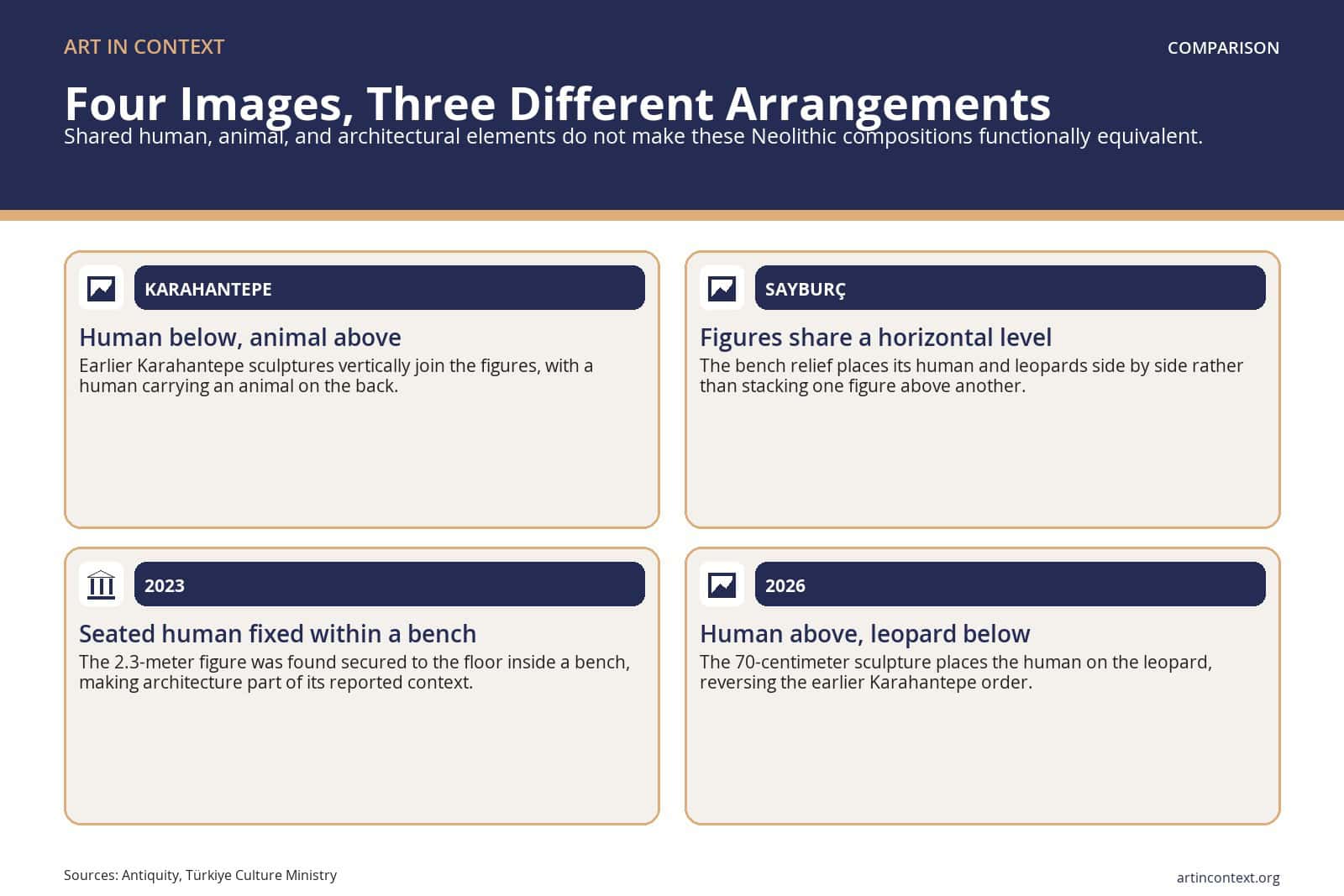
The new sculpture reorganizes that relationship. In the earlier work, the leopard is carried on a human back; in the 2026 find, the human occupies the leopard’s back. This is a demonstrable reversal of the figures’ physical order, not proof that their symbolic meanings were also reversed.
| Record | Composition and setting |
|---|---|
| 9400–8000 BCE catalogue range | Karahantepe human carries a leopard; 164-centimeter limestone sculpture. |
| Found 2021; published 2022 | Sayburç man is flanked by two leopards carved on a bench. |
| 2023 Karahantepe find | Monumental seated human figure was installed within a bench. |
| 2026 Karahantepe season | Human sits on a leopard; 70-centimeter sculpture found on a bench. |
A peer-reviewed study of the Sayburç relief adds a regional comparison. Eylem Özdoğan records a high-relief male figure facing into the room, with profile leopards on either side showing open mouths and visible teeth. The figures form part of a longer carved panel dated to the ninth millennium BCE. Unlike both Karahantepe sculptures, Sayburç arranges the human and felines horizontally rather than stacking one above another.
Karahantepe’s 2023 monumental human statue belongs beside this sequence for a different reason. The Ministry’s 2023 record describes a 2.3-meter seated figure with an expressive face and emphasized ribs, spine, and shoulder bones, set within a bench and fixed to the floor. It does not contain a leopard, but it shows that bodily scale, posture, and architectural placement were already central concerns at the site.

Earlier Karahantepe sculpture of a human carrying a leopard. Photograph by Dosseman; cleaned-up derivative by Pataliputra!, via Wikimedia Commons, licensed under Creative Commons Attribution-Share Alike 4.0 International.
The Bench Context Is More Than a Location
The repeated mention of benches is visually important, although the three cases are not interchangeable. At Sayburç, the images were carved into the inner face of a bench in an approximately 11-meter communal building. The 2023 Karahantepe figure was installed within a bench. The newly announced sculpture was found resting on top of one in a much smaller, three-meter structure.
Those distinctions prevent the architecture from becoming a shortcut to “ritual.” Özdoğan argues from the size, construction, and imagery at Sayburç that its building accommodated special gatherings. The Ministry has not assigned a function to the smaller 2026 structure, and a bench alone cannot establish whether it served ceremonies, storytelling, display, storage, or another activity.
What the reported placement does establish is that the new sculpture was encountered in relation to a room, wall, floor, and seating-like feature rather than as an object lacking architectural context.
Power and Control Remain Interpretations
Jens Notroff, a Neolithic archaeologist at the German Archaeological Institute who was not involved in the excavation, told Live Science that the new arrangement resembles a mirrored version of the known animal-over-human type. He suggested that mastering a dangerous leopard could evoke power or control, with courage or strength among the possible associations.
That is an attributed interpretation, not an excavation finding. The Ministry identifies the upper figure only as human and does not state its sex. “Human seated on a leopard” is consequently more precise than “man riding a leopard,” which adds both a gender and a sense of transport or mastery not established by the official description.
The absence of writing makes repeated imagery especially valuable, but it also limits certainty. Responsible interpretation of prehistoric art must distinguish a recurring motif from a decoded message. Karahantepe now has at least four vertically joined human-leopard compositions: three earlier sculptures with humans carrying live leopards and the new sculpture with the order reversed; this makes the relationship significant without telling us what either arrangement meant.
A Reversed Motif With an Undecoded Meaning
A precise date, stratigraphic phase, the human figure’s sex, the building’s use, and the sculpture’s intended meaning remain unknown; Dokuz Eylül University archaeologist Ergun Lafli identifies the material as local Şanlıurfa limestone, while Notroff’s power-and-control reading remains a scholarly hypothesis.

Isabella studied at the University of Cape Town in South Africa and graduated with a Bachelor of Arts majoring in English Literature & Language and Psychology. Throughout her undergraduate years, she took Art History as an additional subject and absolutely loved it. Building on from her art history knowledge that began in high school, art has always been a particular area of fascination for her. From learning about artworks previously unknown to her, or sharpening her existing understanding of specific works, the ability to continue learning within this interesting sphere excites her greatly.
Her focal points of interest in art history encompass profiling specific artists and art movements, as it is these areas where she is able to really dig deep into the rich narrative of the art world. Additionally, she particularly enjoys exploring the different artistic styles of the 20th century, as well as the important impact that female artists have had on the development of art history.
Learn more about Isabella Meyer and the Art in Context Team.
Choose Art in Context as a preferred source to see more of our reporting in Google Top Stories and other Google Search experiences.
Cite this Article
Isabella, Meyer, “Karahantepe’s Human-on-Leopard Sculpture Reverses a Neolithic Motif.” Art in Context. August 28, 2026. URL: https://artincontext.org/karahantepe-human-on-leopard-sculpture/
Meyer, I. (2026, 28 August). Karahantepe’s Human-on-Leopard Sculpture Reverses a Neolithic Motif. Art in Context. https://artincontext.org/karahantepe-human-on-leopard-sculpture/
Meyer, Isabella. “Karahantepe’s Human-on-Leopard Sculpture Reverses a Neolithic Motif.” Art in Context, August 28, 2026. https://artincontext.org/karahantepe-human-on-leopard-sculpture/.


