

Rembrandt’s Portrait of Catrina Hooghsaet Faces Second UK Export Bar

The UK has placed Rembrandt’s 1657 Portrait of Catrina Hooghsaet under a temporary export deferral for the second time in eleven years. A domestic buyer has until December 26, 2026, to show serious interest at £71,696,324.90—more than twice the 2015 matching price—and the official national-treasure case is now broader than the formal finding recorded the first time.
Rembrandt’s Export Bar Returns at Twice the Price
In a notice published on August 27, 2026, the UK Department for Digital, Culture, Media and Sport deferred a decision on the painting’s export license through December 26 inclusive. This is a temporary pause, not a permanent prohibition. The owner then has 15 business days to consider qualifying offers at the recommended £71,696,324.90, plus £754,698.15 in VAT. If an option agreement is signed, a second deferral lasting nine months begins.
The painting has already passed through one nearly identical process:
| Date | What happened |
|---|---|
| 2015 | Private sale; £35 million export match; application withdrawn. |
| 2016–2019 | Three-year loan to National Museum Cardiff. |
| 2025 | Christie’s-brokered private sale recorded. |
| 2026 | New match set at £71.696 million before stated VAT. |
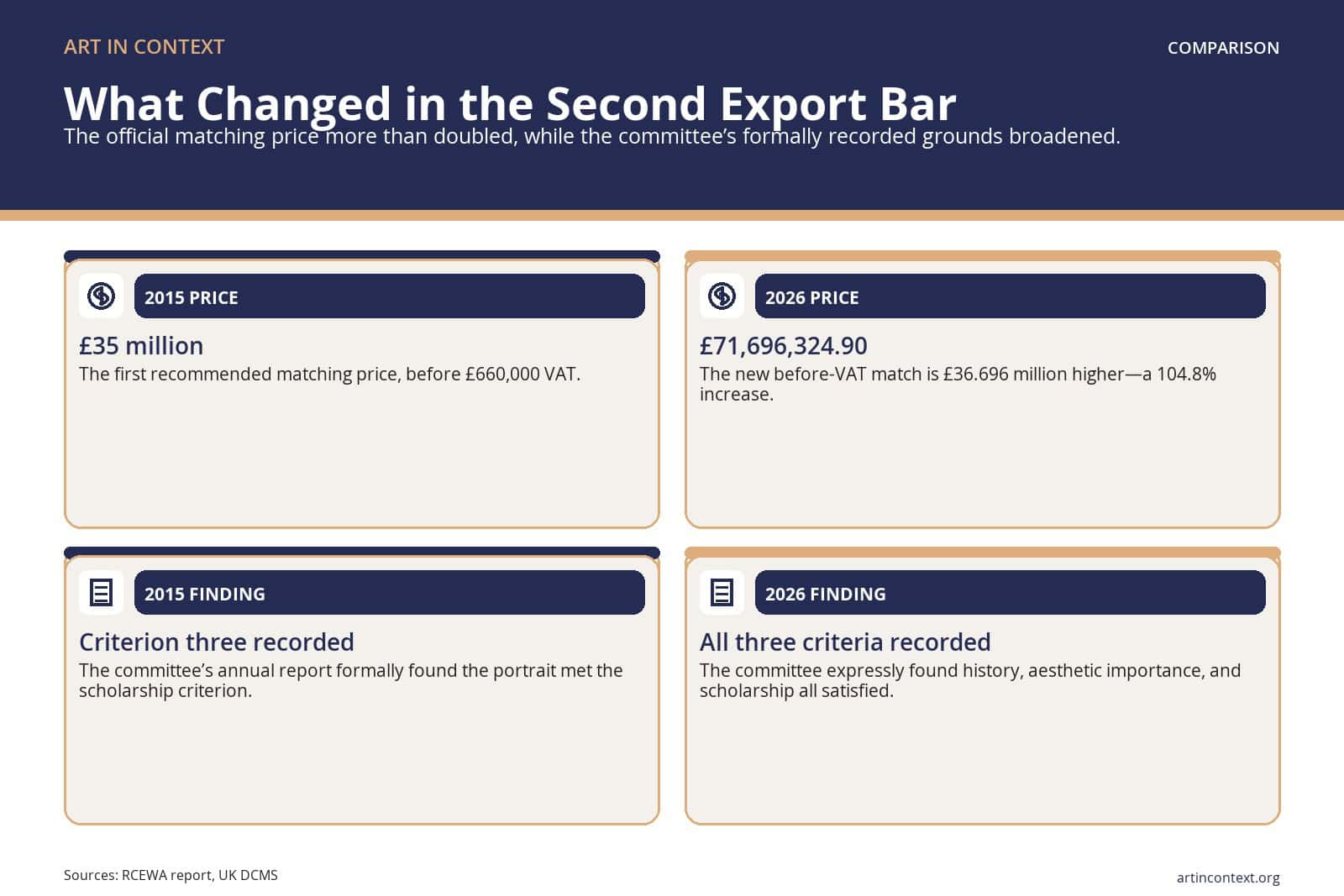
Comparing the two before-VAT figures, the new requirement is £36,696,324.90 higher, an increase of 104.8 percent.
That figure is not a disclosed 2025 sale price. The government calls it the recommended matching price and separately records a Christie’s private sale in 2025. Artnet News reported that Christie’s confirmed brokering that transaction but declined to identify the seller or buyer or disclose the deal figure. The match, the transaction, and the valuation therefore cannot be treated as interchangeable facts.

Rembrandt van Rijn’s Portrait of Catrina Hooghsaet (1657), photographed at the Rijksmuseum by Txllxt TxllxT and hosted by Wikimedia Commons, under the Creative Commons Attribution-Share Alike 4.0 International license; cropped.
Why the Waverley Finding Is Different in 2026
The Waverley system asks three separate questions. Criterion one concerns an object’s connection to British history and national life; criterion two concerns outstanding aesthetic importance; criterion three concerns outstanding significance for scholarship. Meeting even one can support a deferral.
The government’s contemporaneous press notice described the 2015 recommendation in language covering all three grounds. However, the RCEWA’s 2015–16 annual report makes a finer distinction: the expert adviser objected under all three criteria, while the committee recorded its own finding under criterion three, the painting’s significance for studying Rembrandt’s oeuvre and late work. The report also says the export applicant did not dispute the aesthetic and scholarship cases. It does not say the committee rejected criteria one or two.
The 2026 notice, by contrast, expressly says the committee found that the portrait met all three criteria. It ties the history test to the painting’s presence in Britain since at least the mid-18th century and its role in British Rembrandt collecting; the aesthetic test to its unusually refined finish; and the scholarship test to portraiture, Rembrandt’s practice, the documented sitter, and collecting history. The public language overlapped in 2015, but the committee’s recorded formal conclusions did not.
Catrina Hooghsaet Is More Than a Famous Name
The export case depends on the painting’s artistic and historical density. The canvas identifies its sitter and age in the upper-left inscription: Catrina Hooghsaet, 50, painted by Rembrandt in 1657. She was an affluent Amsterdam Mennonite who lived separately from her husband, a circumstance that gives unusual documentary context to a commissioned portrait.
A Museum Wales interpretation reads the details as a negotiation between restraint and status. Her black dress and white cap signal Mennonite sobriety, while silk, pearls, gold head-irons, and a handkerchief indicate wealth. The museum also notes that Rembrandt moved her hands to the chair arms, giving her an authoritative pose more commonly associated with male sitters. Her gaze turns toward a parakeet rather than toward a companion portrait of her estranged husband.
Those tensions place the work squarely within the mercantile and religious world of Dutch Golden Age art, yet Rembrandt resists reducing Hooghsaet to a social type. Precise passages in the face and costume coexist with softer, less resolved areas and dramatic light. That selective finish is also useful when comparing the commissioned portrait with Rembrandt’s self-portraits, where age and social presence likewise become part of the painted subject rather than imperfections to conceal.
Museum Wales notes that Rembrandt never painted Hooghsaet’s husband and that she looks instead toward her pet parakeet. The portrait’s research value consequently lies in the conjunction of paint handling, gendered portrait conventions, religious identity, luxury consumption, and an unusually well-documented life—not simply in the fame of its maker.
Can a UK Collection Mount a £71.7 Million Campaign?
The government describes the portrait as the most expensive object ever given UK national-treasure status. Yet its August 27 notice names no prospective purchaser and announces no fundraising campaign. The initial window establishes whether an appropriate UK buyer has serious intent; it does not itself secure public ownership.
The 2015 precedent shows how different the published price can be from a museum campaign’s practical target. The Art Newspaper reported at the time that tax advantages would have reduced the Art Fund-led campaign’s requirement from £35 million to £22.5 million, and that significant charitable funds had already been secured. The owner withdrew the export application before that public appeal began.
No equivalent tax-adjusted target appears in the 2026 announcement. Until a buyer and funding structure are identified, £71.696 million is the official matching figure, not necessarily the amount a public campaign would ask individual donors to supply. It is not a ready-made fundraising goal.
The earlier episode also separates three outcomes that are often blurred: location, access, and ownership. Withdrawal kept the painting physically in Britain; the later Cardiff loan gave the public three years of access; neither transferred title to a museum. This second deferral will matter most if it converts temporary presence into a durable public arrangement.

Rembrandt van Rijn, Self-Portrait, 1658. Public domain, via Wikimedia Commons.
A Doubled Price and a Broader National-Treasure Case
The official 2026 match is £71,696,324.90 before the specified VAT, 104.8 percent above the 2015 figure, and the committee says all three Waverley criteria are satisfied.

Isabella studied at the University of Cape Town in South Africa and graduated with a Bachelor of Arts majoring in English Literature & Language and Psychology. Throughout her undergraduate years, she took Art History as an additional subject and absolutely loved it. Building on from her art history knowledge that began in high school, art has always been a particular area of fascination for her. From learning about artworks previously unknown to her, or sharpening her existing understanding of specific works, the ability to continue learning within this interesting sphere excites her greatly.
Her focal points of interest in art history encompass profiling specific artists and art movements, as it is these areas where she is able to really dig deep into the rich narrative of the art world. Additionally, she particularly enjoys exploring the different artistic styles of the 20th century, as well as the important impact that female artists have had on the development of art history.
Learn more about Isabella Meyer and the Art in Context Team.
Choose Art in Context as a preferred source to see more of our reporting in Google Top Stories and other Google Search experiences.
Cite this Article
Isabella, Meyer, “Rembrandt’s Portrait of Catrina Hooghsaet Faces Second UK Export Bar.” Art in Context. August 28, 2026. URL: https://artincontext.org/rembrandt-catrina-hooghsaet-second-uk-export-bar/
Meyer, I. (2026, 28 August). Rembrandt’s Portrait of Catrina Hooghsaet Faces Second UK Export Bar. Art in Context. https://artincontext.org/rembrandt-catrina-hooghsaet-second-uk-export-bar/
Meyer, Isabella. “Rembrandt’s Portrait of Catrina Hooghsaet Faces Second UK Export Bar.” Art in Context, August 28, 2026. https://artincontext.org/rembrandt-catrina-hooghsaet-second-uk-export-bar/.


